6 Ways Schools Could Open Doors for Students with Special Needs

opening doorsPublic schools are being asked to do so much right now, and so much of what they are being forced to do is a waste of time. Music and the arts are being cut, students are overloaded with standardized tests, and even recess is being shortened so work can be completed. In short, schools are being forced to run like businesses, but our children are not raw materials, nor are they products.  They are children.  And when the pendulum swings back (I hope to God it does), when more rational heads prevail in remembering that we are teaching human beings how to be human beings, rather than filling little heads with facts, maybe then the schools will have an opportunity to begin filling gaps and opening doors for our students with special needs.  Here are some ways they could begin:

  1. Mentor/Mentee programs These programs connect students with an adult in the school community who can meet with them on a regular basis, build a positive relationship, and provide guidance to students.  The Boy has built this kind of relationship with the business and computer teacher at school, quite organically.  He doesn’t even have her as a teacher, but they use time with her as a reward for positive behaviors at school, and she is often a reason he wants to go to school.
  2. Peer to Peer programs I’ve written about how successful these programs can be not only for students with special needs, but for typical students, as well.  Building Relationships between kids, and providing avenues for them to learn about each other as people can only result in good things. When everyone’s needs are met, bullying just isn’t a thing.
  3. Peer Mediation programs These programs foster conflict resolution skills in our young people.  At first they are taught and coached through the steps of providing mediation for peers who are in conflict.  After practice, they become second nature, and the students involved with these programs become leaders, as they have the skills to help their peers relate to each other in positive ways.
  4. Social Skills programs Carving time out of a busy school day to provide direct instruction to students about how to initiate and maintain positive social interaction seems like it makes perfect sense for those students who naturally have defects in this area.  It can also make perfect sense for those students you may assume has these skills already, but may not, or may struggle with these skills privately.
  5. Critical Thinking Instruction More than anything else, we need to be teaching students how to really think, rather than regurgitate readily available information.  We need to be teaching them how to make rational decisions, how to determine whether a source is credible, how to examine their own thoughts and opinions, and how to interpret the world around them.  For special needs students, this can be especially difficult, but even more necessary as we prepare them for their adulthoods with varying degrees of assistance.
  6. Creativity and Problem Solving Instruction Children today do not have much opportunity to be creative.  And when we cut art and music programs, we are essentially saying that being creative is not a high priority in today’s job market – what could be further from the truth? There are many ways teachers can provide opportunities within their current limitations to foster creativity and problem solving, and many ways we can help special needs students be creative.

The great thing about school programs that benefit students with special needs is that they often benefit all students.  We assume that typical kids don’t struggle with the same things as those with special needs do, but they do.  They are often better at hiding it, because it may not be as dire a struggle.  What middle schooler do you know that wouldn’t benefit from a social skills class or a peer to peer program?  What kindergartner wouldn’t benefit from some opportunities to be creative?  What person on Earth would not benefit from having a mentor?

When we finally do something to correct the course of public schools, and begin to focus on the person rather than the content, these 6 programs would be a good start to guiding all of our students to being better human beings.

How Do You Know?

I saw a tshirt advertised on facebook the other day that read in big block letters, “I AM A MOM OF A CHILD WITH AUTISM,” and I thought, “Hm.  Don’t need that!” And then I thought about how quickly I assumed others know that about me, about us, about The Boy.

The Boy doesn’t flap much, doesn’t stim much when we’re out and about.  He saves it primarily for when he takes long walks outside, back and forth either in front of our house, or in front of Grammy’s.  Sometimes, he does it in his room, or from the kitchen to his room.  His stimming looks like an uncoordinated gallop with a sound like a voice-cracking “giggle” that could attract some stares from the un-initiated.  But I can’t recall seeing him do this at the grocery store or at a restaurant, where others may have cause to stare.

I’ll tell you when they do know.  They know about 2 seconds after they ask him a direct question.  They know when he bumps into them and keeps right on walking.  They know when he walks directly between two people that are together.

Every once in awhile, we come across some old, uppity lady who takes affront, but in general people don’t do much more than notice and go about their own lives.  So no, I don’t need a T-shirt.  Whatever people may assume, or learn after a brief encounter with us – it doesn’t much matter to me. As long as they are tolerant and kind, the rest doesn’t matter.  The tolerance and kindness will not be created by a T-shirt, but through hard work, writing, speaking, spreading the word, creating as many programs for NT kids about acceptance as there are for spectrum kids about how to fit in, volunteering, and sharing, sharing, sharing… That begins with us. Ready?

The Man, The Teacher

Can I just start this post off by saying I know how incredibly lucky The Boy and I are? I know there’s a lot of single mamas out there with kiddos with special needs, and I know that loneliness, and that feeling of hopelessness that you may never find someone to share your joys and burdens. I write this post in gratitude that life, circumstance, karma, or whatever or whoever you may think had a hand in it, helped us get to be this blended family of three.

The Man is a natural teacher and kid magnet.  Whenever we go to the beach, he picks out a couple of kids who show even  the slightest interest in his surfboard, puts them on, gives them a few pointers and lets them fly.  And after about 10 minutes, a whole beach-full of kids wants a turn.  Our little neighbor often comes over to see if The Boy wants to play, and just as often ends up “helping” The Man with his projects around the house, wearing his tool belt, and learning how to use a power screwdriver, under the closest of supervision, of course.

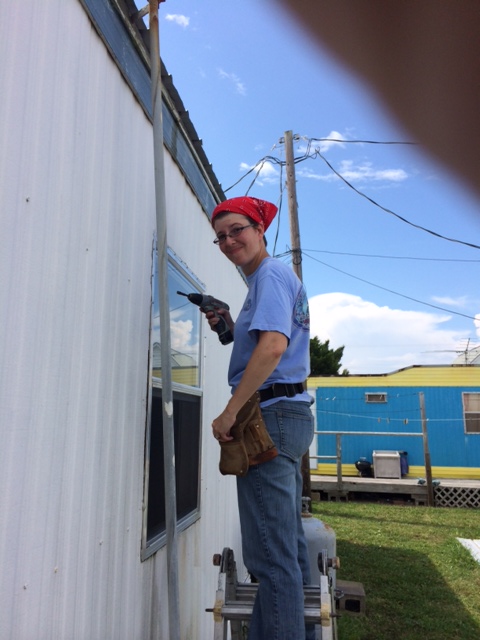
He shows me how to do stuff all the time.  I put windows into our trailer flip all by myself, you know, and I didn’t know how to do that before I met The Man.

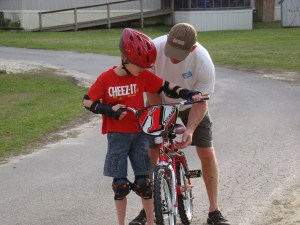
He was the one to teach The Boy to ride his bike.  He taught him how to pee while keeping his trousers up.  He’s taught him how to surf and mow the lawn.  The other night, The Man had brought home some m&ms for The Boy and had told him he could have them when he was done practicing the tuba. But when The Boy and I ended the practice session, I was frustrated.  He is so freakin’ smart that he thinks it’s funny to play it incorrectly and doesn’t know when to stop joking around and get work done.  This is something we’re working on, and this lesson just didn’t go right. I was tired of everything and decided to go to bed early.  The Boy quickly grabbed the m&ms and headed to his room.  In his mind, he was done practicing which meant he could have them, while The Man and I both agreed that you only get rewards when you do things the right way.  I gave up and headed to bed, very aggravated and  unwilling to fight anymore.  The Man stepped in and I could hear him speaking to The Boy through the bedroom door. He came to bed and said he had explained that we needed to save the m&ms for when he actually got the work done on the tuba, and asked him to think about it, and also suggested that when he returned the m&ms to the fridge, he needed to come and tell me he had done so.

I was so impressed. The Man had calmly explained the reasoning and left it in The Boy’s hands to do the right thing.

Not five minutes had gone by when we heard a knock on the bedroom door.  The Boy entered to tell me he had returned the m&ms, and I assured him he could earn them the next night by completing our work on the tuba. He wasn’t happy about it, but he wasn’t melting, either, and he had made the right choice, guided by The Man’s words.

This is something that would not have occurred if his dad had been around.  This is something that would not have occurred if I was still doing it all on my own.  This occurred because The Man is a good teacher, and a good parent. I am grateful.

6 Basics I Sometimes Forget from Autism 101

One of the hardest parts of being an autism parent, especially in the beginning is deciphering your kid and his behavior.  Why in the world is he doing that?  What is he so angry about?  Is this a tantrum or a meltdown? Why can’t I get him to (insert any activity here)?

As you grow as a unit, you begin to understand more about how your kid works. You get better at predicting behaviors, and identifying triggers (more on that in another post this week). Your skills and knowledge increase exponentially.

Autism101And yet, as I’ve written before, you will always have your moments of complete and utter dumbfoundedness (is that a word? If it wasn’t, it is now), and better yet, you forget sometimes about stuff I like to call “Autism 101”.

So what are the “Autism 101” basics I forget from time to time?

  1. One of the biggest culprits for negative behaviors is a virus.  I will get phone calls or emails from the school, out of the blue about work refusal from The Boy, or escaping from class, or any number of negative behaviors.  My first instinct is still defensive, i.e. “What did you (the teacher or aide) do to trigger his behavior?”.  And that is simply because he is a good kid, and doesn’t act out.  He hates displeasing me or The Man or his grandparents, and when this behavior happens, there’s a reason.  What I often forget is that a common reason has nothing to do with action and reaction, and everything to do with cold and flu.  Viruses do a number on his system, and much like a computer, he starts acting very strangely indeed.
  2. Another big culprit for negative behavior is (forgive me) an upcoming bowl movement.  You see, The Boy had surgery as an infant, in which they removed part of his intestine, and moved some things around in there.  As a result, well… let’s just say that if there was a super-duty (heh, heh… I said “doody”) wide-throated toilet, we’d have it.  And much like the wonder of childbirth, I really don’t understand the physics of how something so big can come out of something so small.  As a result, poops are not regular, nor are they fun.  And I have found that sometimes they are preceded by some really wonky behavior.
  3. He may say he’s not hungry, but give The Boy a snack because hungry turns into negative behavior. This is one instance where trying to respect your child’s independence, and listen to their voice and burgeoning self-advocacy does not work.  If you don’t give him anything, he will become even more absorbed in what he is doing until his body forces him to react to the hunger, and it’s rarely in a good way.
  4. The Boy is verbal, but still lacks language.  The Boy loves words, finds words funny and punny, and is able to express and receive language.  He is in a high-functioning autism pilot program, even though he would not have been classified as having Asperger’s Syndrome.  He had language delays as a toddler – I had to teach him language with flashcards, and he went to speech therapy twice a week for a long time.  He does really well now, but he still lacks language to express himself appropriately sometimes.  There are situations where he cannot find words to say what he wants to say, so he leads me to the right guess.  But sometimes I can’t guess, and I have to remember that even though he has high functioning language skills, they were hard-earned, and this is not natural for him.
  5. Pictures, pictures, pictures, pictures, pictures. Sometimes I will ask myself, “Why is he not understanding this?” and I have a “Doh!” moment and think, “Maybe because you just told him about it, and didn’t use any pictures, dummy!” There’s a reason well-respected autism professionals talk about picture schedules until they are blue in the face – it’s because they work.  Our kiddos are generally very visual learners, and if something just isn’t sinking in, a video or picture will usually do the trick.
  6. Intrinsic Motivation just isn’t it.  Rewards and motivators are king.  And I’ll be honest – I don’t forget this one (as sometimes The Boy’s teachers at school seem to), but I do forget to have a ready supply of rewards and motivators in my bag of tricks.  When I don’t have something at the ready, I sometimes resort to taking away privileges, which doesn’t work nearly as well. More on this in the upcoming behaviors and triggers post…

How is it possible to forget this basic stuff that one should know after 13 years of experience? Because there are peaks and valleys to child development, and even bigger peaks and valleys in the development of a young person on the spectrum (in my personal experience).  There’s a lot of backtracking, having to recoup skills that were considered mastered, and as they grow more independent, you forget they are still kids, still learning.

There is no mastering of parenting, I’m convinced. It’s Murphy’s Law – once you think you know everything, you will be quickly shown that you do not.

Peer to Peer: How to Make Sure Pranks on Kids with Autism Don’t Happen

There are too many stories of horrific acts done to kids on the spectrum these days.  The ice bucket challenge “prank” in Ohio, the boy in Pittsburgh duct-taped to a soccer goal… Targeted hate crimes if you ask me.  I’m appalled that schools and law enforcement seem to be utterly reactive in these situations, as well.  Taking plenty of time to “investigate” while handing down weak “discipline”.  It is so utterly disheartening to read about these attacks.

What I know is that the chances of that type of thing happening in the district where The Boy went to school from kindergarten through 5th grade were  and are slim to none.  Why?  Because they were proactive.  When they created an autism program, they also created a program for the neurotypical students that would be encountering this population in their classrooms.

In The Boy’s case, it started as “Grub Club” where the kids in the ASD program were able to go out into the community for lunch once a month and invite an NT student/friend.  The kids in the spectrum get real practice using social skills, and the NT kids get to know the ASD kids as real people, away from the peer pressure.

Grub Club morphed into the LINKS program (more info here), and by the time The Boy was in 5th grade, almost the entire 5th grade class had signed up to be a LINK.  They received special “training” and volunteered to buddy up with their ASD friends in class on projects.  When I watched The Boy and his classmates, they never hesitated to help him find where to go at the choir concert, and never refused a birthday party invitation.

friends

You can’t expect neurotypical kids to know how to deal with kids on the spectrum.  You can hope their families have given them some good training on how to treat other human beings, but sadly, this is not even the case the majority of the time.  If you are going to teach my kid with autism how to react to the neurotypical world, you had better also be teaching those NT kids how to deal with my kid with autism.  When you don’t, you are missing teaching lessons as important as anything in the Common Core.  And maybe your district will be the next one on the national news, dealing with some horrific act perpetrated by your students who were never taught these important life lessons.

Sleepovers: Spectrum Style

Last Saturday, we invited The Boy’s best friend over for a sleepover.  He is on the spectrum, too, and is in The Boy’s program at school.  They get along really well together, share the same interests, and this boy just seems to get it when The Boy doesn’t answer a question or doesn’t want to do the same thing he does.

The two spent the morning at our Autism Society’s chapter’s “Friends and Fun” party, during which everyone who celebrates a birthday for that month gets to come to a church youth group center and hang out for a couple of hours.  Presents are given by the chapter, and there’re cupcakes, so it is a great way for the kids to get together without the pressure of a formal birthday party (and figuring out whom to invite).

Then I picked them up and brought them to the beach trailer that The Man and I are renovating… Have I told y’all about that?  Not yet?  Another post entirely…

They waited patiently while I put in a new window…

window work

And then The Man, the boys and I walked over to McDonald’s for some lunch and some much needed sweet tea.

Next, I drove the boys up the way a bit to a bowling alley that we had heard also had an arcade.  After getting lost twice (thank you, iPhone!), we found the place and proceeded to spend quarters on slightly beat up machines that didn’t always give us tickets.  The boys had a great time playing foosball and air hockey, and ended up with some fantastic plastic slinky bracelets that promptly broke within the next half hour.  But it was fun 😉

foosball

We stopped at Target to see if the Halloween costumes were out yet, which they weren’t, but we had a good time poking around the legos and stuff, and they were patient with me while I poked around in the office supplies, ogling washi tape.  We picked up a couple of toys for Raphael, too.

On the way back home, we stopped at a Halloween superstore, as The Boy’s friend seems to have an obsession with Halloween and the haunted house he and his parents create in their garage every year.  This superstore actually had a small haunted house setup through which you HAD to walk to get into the store.  The Boy’s friend seemed to like it and be scared by it at the same time, while The Boy was just scared.  We checked out the costumes, and I think The Boy was most traumatized by the fake boobs in one of the aisles.

We headed back to the beach trailer to see The Man’s progress and then headed over to one of the piers with a restaurant (and a great view), ate dinner, and walked out on the pier after dark.

pier at dusk

We headed home and let the boys do their thing with DSs and iPads and computers – oh my!  As The Man and I headed to bed rather early – he tired from the physical work of putting in new sub-floor by himself, and me tired from entertaining two preteens for the past 9 hours.

Let’s just say I’m glad it doesn’t happen every weekend, but I am SO glad The Boy has a friend to be able to do this with.  It’s a small slice of normal for him, and he loves it.

Boys in the Bathroom

The Boy has had his first encounter with bullying at school.  I should say teasing, because bullying is really defined as a repetitive, targeted behavior, and I have no evidence that this has been going on for any length of time.  Truth be told, I was very happy with the way the school personnel handled it, and took some responsibility, as well, because we kind of knew this particular instance might happen.

Let me explain.

When we first moved south, The Man noticed that anytime The Boy went into a public bathroom, he had a tendency to “drop trou” to go pee, meaning he would drop his pants in order to do his business.  Apparently, this is not typical male behavior in a restroom – I would not know that, having never been a part of this particularly male experience.  When The Man told me about it, and explained that he just couldn’t do that, I didn’t have an answer as to how to fix it — this is not something that I am equipped to teach him.  And having hit puberty, The Boy was certainly not going to let me anywhere near him while he was anywhere near peeing.  This was clearly a dad’s job, and you can understand why a step-dad may be less than comfortable with the responsibility.  We ended up urging The Boy to use a stall when possible.

Fast forward to the second week of school, when I got an email from The Boy’s program teacher explaining that The Boy had been teased about doing just this, and talking to others while peeing, as well.  Another group of boys reported the teasing directly to one of his team teachers, for which I am grateful and appreciative, and that teacher actually had another teacher cover his class that same day so that he could take the offenders to the teachers lounge and “read them the riot act” over the incident. “We just don’t tolerate that here,” he explained via email.

I called The Man and we decided The Boy needed a lesson in how to pee in a public bathroom, and that The Man would be the one to do it.  He didn’t balk, he didn’t hem or haw.  That evening, he said, as calm as ever, “Hey, I need to show you how to pee,” and The Boy said, “Alright.”

The Man and I exchanged a look, complete with two pairs of raised eyebrows…

The Man pretended our living room wall had two urinals on it, which The Boy liked, with his toilet obsession and all. The Man then proceeded to break the process into steps. “You put your thumbs here in your waistband, and pull down,” and they practiced as they faced the imaginary urinals on the wall. He explained the whole process, and explained that the reason boys do it that way is so that they don’t show their butt to everyone else, so it can be more private.  The Boy paid attention, and seemed to understand.

The Man and I were relieved that The Boy seemed so willing to take instruction, and we can only hope he is using his new-found knowledge.

In any case, I was proud of them both.  Sometimes a man’s gotta do what a man’s gotta do.

Inclusion is still not a “thing”?

While reading the recent NPR article about inclusion, I realized that it’s still a subject of controversy, which puzzles me.  Because to me, the issue of inclusion is about basic human rights.  In America, every kid has the right to a free education, and the notion that some kids who “hinder” or “distract” kids who will actually make a “net contribution to society” and should therefore be stuck in a room somewhere sounds like something out of the 50s and 60s.  Have we really not traveled so far as to realize the “worth” of every human being, and their basic human rights, even in this country?

Wow.

I have to say I’m gobsmacked.  Many commenters were concerned about gifted kids being placed centrally in a classroom so they could help their peers during lessons, as if that were a disservice to that gifted child.  What?  We want to discourage helping others, now?  Because not being placed centrally in the classroom would help her achieve higher levels of giftedness?  Help me understand…

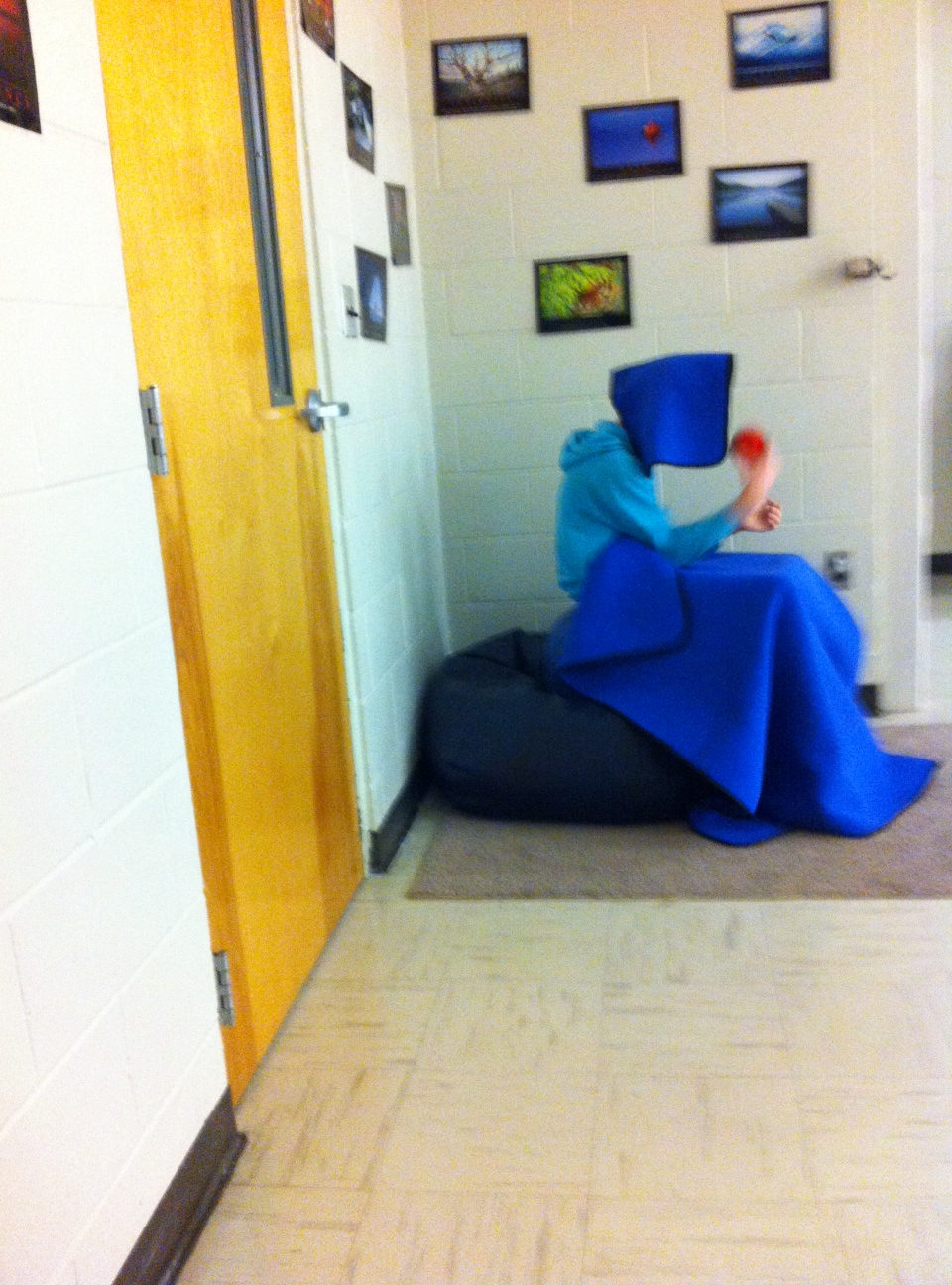
The Boy in his ASD room with compression blankets, sitting atop a pilates ball

The Boy in his ASD room with compression blankets, sitting atop a pilates ball

I am not necessarily a proponent of full inclusion, except when a student with disabilities is best served with full inclusion.  I prefer for my kid to have a safe space and some downtime in his school day, so that he doesn’t have to be “on” all day long.  I love that he has a space where he can be his true self, at least during lunch, and his social skills class.  If he didn’t, he would be ready to blow every day when he got home, and that ain’t good for anybody.  So I appreciate the sort of inclusion he gets – “Inclusion lite”, if you will.

But as I wrote in my recent post, I want him to be able to socialize with his neuro-typical peers, because that’s a thing.  He will need that in his lifetime, in order to succeed to the best of his abilities.  And in my humble opinion, he will need that more than knowledge about the Pharoahs of Egypt.  I want him to belong to his school community, and that just won’t happen if he is stuck in a separate room all day.

I shouldn’t let the trolls get to me, but every human being has worth, and my kid has more than most.  He deserves the same respect as every other kid on the block.  And he does have a very basic right to the same education every other 6th grader gets.

Extra-Curricular Activities and the Autistic Child

I read and shared a great article the other day, written by Laura McKenna, entitled, “Our Public Schools Must Be More Autism-Friendly — Here’s Where to Start,” and published on the Pacific Standard Magazine website.  In it, Ms. McKenna highlights ways in which schools could be more inclusive with their extra-curricular offerings.  She makes an excellent point, as may of the kids I know on the spectrum do not participate in clubs and sports, due to the level of social sophistication that is required for inclusion.  But that only allows our children partial access to everything the school experience has to offer.

The Boy and I have made the decision to continue with school band next year.  I have spoken to the band director, and we are going to take a proactive approach, and really monitor what needs to be modified and accommodated for him, even in terms of performances.  I am comfortable with that, and if I ever get uncomfortable with the situation, I can pull The Boy out and continue with private lessons, which was my intention when the whole band debacle went down this winter.  But here’s the thing: I realize now what a social thing school band is, and I understand that this may not work out for The Boy, and that’s OK.  But I still want him to belong to his school community, and if it won’t be through band, then how?

We have mostly stuck with independent stuff like surfing

We have mostly stuck with independent stuff like surfing

When he dropped him off after spring break, his dad told us all about how they played basketball, and The Boy has a great shot.  They also worked on catch, but were not as successful, and they would work on that (uh, right).  Sure, if The Boy has interest in playing sports, we could encourage it, but to what end?  School sports are also social in nature, with the necessity to read cues from teammates and opponents and to quickly interpret them and decide on a course of collective action – a tall order for someone with underdeveloped social instincts and executive processing difficulties.  So he shoots free throws by himself?  Again, how does this help him fit into his school community?

Our local Autism Society Chapter has taken on the challenge to fill this void in our community, and I applaud them for it.  They have been recognized statewide for creating a “Friends, Fun, and Birthday Club” which happens once a month to celebrate all of the kids birthdays that happen that month.  Friends, siblings, and those on the spectrum are all invited – anyone can attend, and since Birthday Parties are kind of a sore spot for the autism community, this meets a very strong need, and is quite successful.

They also have a once-per-month fundraiser at a local pizza restaurant, which has turned out to be a social gathering for the kids on the spectrum and their siblings.  They all sit at the same table, away from their parents, and they bring their DS’s and gameboys and have a good ol’ time.  It is a sight to behold, and I almost get teary-eyed watching them together.

The chapter offers monthly music and art programs for the kids to participate in, too,and again, friends, siblings, and kids on the spectrum are all welcome.

But again, this is all outside of the school community.  Inclusion needs to happen outside of the classroom, as well, and it is high time our schools begin to recognize the void in our kids lives.  Yes, we want to allow them the comfort of being alone, but as adults on the spectrum will tell you, they also want to have friends and be a part of the larger group.  We have to help them do that, and developing programs to address those needs is long past overdue.

I’m off to share this article with my son’s principal…

Once You Get to Know Him

IMG_1303Throughout his life, The Boy has attracted a great number of fans.  He has lots of people who love him deeply, including Fantastic Babysitter, his former ASD teacher(s), and lots of caregivers and therapists who have made up his support team.  Of course, The Man, The Boy’s grandparents and I adore him, too.  He makes us laugh, and surprises us everyday with his intelligence, sense of humor, and amazing abilities.  And when mentioned by name to teachers and administrators in schools of many hundreds, only his first name is necessary.  Everyone knows The Boy.

But usually, it doesn’t start out that way.

Usually, it takes a while for people to get to know The Boy, as I’m sure is the case with most kids and people on the spectrum.  The very challenges that define the disorder make it difficult for neuro-typical people to get to know him.  They tend to gloss over his human-ness and focus on what he can’t or won’t do for them.  And as they get increasingly frustrated with him, he picks up on it and begins to distrust that person, which increases the likelihood that he will not or won’t be able to do what they need or want him to do.

This is the downward slope upon which we were sliding with his band director.  But as sometimes happens, a realization was made that this kid (The Boy) is freaking awesome, and a second realization comes close behind – “If I was wrong about that, what else was I wrong about?”  As soon as a doubter sees the error of his or her ways, they not only like him, but they become a fan, and a crusader to get him whatever he needs to succeed.

Now that the band director has seen and heard what The Boy can do (including make the entire class – including the band director himself! – laugh with a joke), he has been extremely helpful and communicative.  He emailed after a recent playing test, saying how “proud” he was, probably because, as his program teacher said in her email that day, “his was the best tuba test of the day!”

I will take what I can get – no lie, this is a huge victory for The Boy.  And I absolutely love how loved my boy is.  But it sure would be nice for people to treat him well, and give him the benefit of the doubt before getting to know how awesome he is.  He shouldn’t have to prove it before people will accommodate him.