Wrapping it Up

The Boy has nine and a half more days of school, and where we live, that equates to end-of-grade testing. He has three tests this week, and one next week that attempt to assess everything he learned in the entire school year in all four of his core subjects. I’m pretty sure the educational community determined decades ago that these tests are a poor way to assess any kid’s knowledge, and I can tell you right now, they are a huge waste of time for my kid.

I don’t think he’s passed one since we moved here. Does that mean he hasn’t learned anything in any of his classes? Nope. But they still require them to take them (although, thanks to his IEP, he doesn’t have to pass them to move on to the next grade!).

Testing is hard for my kiddo, anyway. He needs extended time and breaks. All of that means that these tests take him ALL DAY LONG. And he hates them. Wouldn’t you?

This year, for the first time, I’ve heard him self-advocating, complaining about the length of these tests. And unfortunately, there’s nothing I can do about them. But I have offered him a treat after school every day that he has one, as an incentive to “do your best, that’s all you can do!”

Here’s to the teachers and kiddos struggling to slog through the crap at the end of the year so some bureaucrat somewhere can check his box that it was completed. It’s not one of life’s prettier lessons, but it is a life lesson – sometimes you just have to do it, even though it’s stupid. And it’s one we all have to learn, sooner or later.

Good luck!

night-office-shirt-mail

This Battle’s Not for Us

I was thankful for one of The Boy’s former teachers last week. She’s the one they moved to a different school this year, and we’ve missed her sorely.It’s funny to think that when we wanted to move him to his current school, she was not in favor and didn’t think he was right for the program, and she is now one of his biggest advocates.

I voiced all of my concerns over this Occupational Course of Study (OCS) with her – that he wouldn’t be in the least restrictive environment (LRE), he wouldn’t have access to his general ed peers, and he may not be able to take band.

She talked me off the ledge. She made me see some things from a different perspective, and made me realize that if I have to choose, this program could work for The Boy. And that he has every right to be in band, although logistically, he may only be able to be in it for one semester.

And I can live with that, as long as they make the “occupational” part of it something in which The Boy has interest. He won’t be folding towels at the hospital if I can help it.

But that’s not what I’m telling the district. I had contacted the director of special ed, as she had been an ally in getting The Boy his current placement, and had earned my respect. I wanted a meeting, but she said she would call me instead due to expediency. Except that all she wanted to do was sell me the OCS program, and I wasn’t going to let her. I wanted her to explain how it was legal, without placing kids in their LRE. After she figured out I wasn’t going to be sold, she told me she would set up a meeting with the transition coordinator (with whom I already met and wasn’t all that impressed) and the occupational coordinator. She told me she would get back to me the following week. That was last week, and she didn’t.

When I emailed her again yesterday, she said that the transition coordinator had been waiting for my call to answer my questions… What?

I sent an email – you know the one. The one I crafted for an hour, making sure to sprinkle acronym bombs all over the place so she would remember that I wasn’t some ignorant parent who didn’t know anything about student rights or IDEA.

Lo and behold, she was able to set up a meeting after all. For tomorrow. Fancy that!

But, I’ll be honest. This meeting isn’t really for us. I don’t expect them to re-design the entire high school setup for us, because they won’t. I don’t expect them to wave a magic wand and put him in band all year, because they won’t. I don’t expect to hear much but placating platitudes. But I want them to know that I know. And I want them to know that I’m not going away, so that if something isn’t working, I’ll be back. And I want them to know that there is a whole host of kids coming up through their schools, and that if I know that what they’re doing is illegal, they better damn well know that those kids’ parents will know it too. And they better think about just what they are going to do about that.

high school


Anxiety about the Unkown

When I was about 10, my parents and I watched “Iceman,” a movie about a neanderthal man found in ice and resuscitated. The question I had for my mom at the end was if it was ever possible for us to return to that state of being – unfamiliar with the technology of the day, and possessing only the most meager of skills. She answered that it was possible in the event of a nuclear war (this was in the mid-80s). Unbeknownst to her, I began to panic about the possibility of nuclear war, and the media coverage of the cold war only fed my frenzy to the point that I was afraid when I heard planes flying overhead, thinking it was the Russians about to drop the bomb.

My dad finally talked me off that ledge (he really would have been a fantastic teacher or counselor) one night, explaining to me that my fears were not founded in logic, and that I was safe.

I went about my life, and I was fine.

But every once in awhile, I get gripped by a current worry, and it turns into an irrational fixation. The internet is a wonderful tool and the most fantastic invention of our time, but during these moments, it is my worst enemy. Rather than trusting my own intuition, experience, and intelligence, I go searching for an answer from strangers who don’t know me or my situation. The answer must be out there, I tell myself.

how I worryAnd so, with my child’s future seemingly in the balance, and a boy who looked at me with panic in his eyes last night, asking “Do I have to quit band?” this is where I am today. In front of the computer, searching for answers, for someone to tell me the right thing to do. Do I choose one of the pre-existing paths for The Boy to follow through high school, possibly denying him access to college or, on the other hand, subjecting him to years of struggle and stress in general ed classes with little support? Do I try to blaze a new trail and fight for a hybrid that is legally his right (with little hope of succeeding)? Do I fight for  him to be in marching band when I’m not sure whether his love for it is more obsession or genuine interest? Do I just pull him out and homeschool (somehow)?

For my sake, I’m putting it out of my mind for a bit, waiting to hear when the meeting with the director of special ed will occur, and asking for the IEP to be postponed at least a week. Coping through distraction and delay. :/


Orientation

high schoolFor most, high school orientation is an exciting time. I watched the 8th graders sit quietly and listen to the high school administration and teachers speak in the auditorium, and afterwards wander the halls, almost running at times they were so excited to see their friends and figure out how the building was laid out. During the presentation they were told what classes they would have to take as a freshman, and that they may not got the electives they want because they build the schedule from seniors down. They were told about foreign language, core classes, Career and Technical Ed classes, and counseling services.
Not once did they mention IEPs or 504s.

Few teachers were there, and only two out of the three counselors for the entire 900-student population were there. It was not a night designed to speak to teachers, or counselors, even though they made themselves available in the hallway after the presentation.

I spoke to the band director who had been a no-show for a meeting the previous day during my lunch period (drove 20 minutes to the school, waited 20 minutes while he was in a meeting with the principal, drove 20 minutes back to work). He took the wind out of my sails by saying The Boy may be able to participate in band second semester if they add a second, more remedial band like they hope to, but that was pretty much our only option at this point. This Boy who adores band, probably has perfect pitch, and wants to be a band director…

I attempted to speak to the counselor in the hallway to find out just how all of this scheduling would happen with us, but another parent cut right in front of me, and by that time I was frustrated, tired, and hungry so we walked away, and I allowed The Boy one more stop in our wandering tour before leaving.

A registration form came home two days ago, and since, again, I had thought this would be handled by the IEP, I emailed The Boy’s special ed teacher, the one who coordinates his program and the IEP meetings. She responded that she is on indefinite medical leave and had no idea, maybe I should email Mrs. X…

I asked The Boy how long his teacher had been gone. “Since last week,” he said.

As a result of all of this, I am disappointed, anxious, angry, and frustrated. And my attempt to meet with the director of special education was met with a promise of a phone call. I’m afraid if she does follow through with the phone call today, she may get an earful.

Special Education should not be an afterthought, an attempt to comply with the law. Special Education should not be something separate that isn’t talked about. Special Education should not be a reason to exclude kids.

And I should not have to pull teeth to find out information about my child’s educational experiences and program in the coming year.

This is unacceptable.

Keys to Independence Challenge

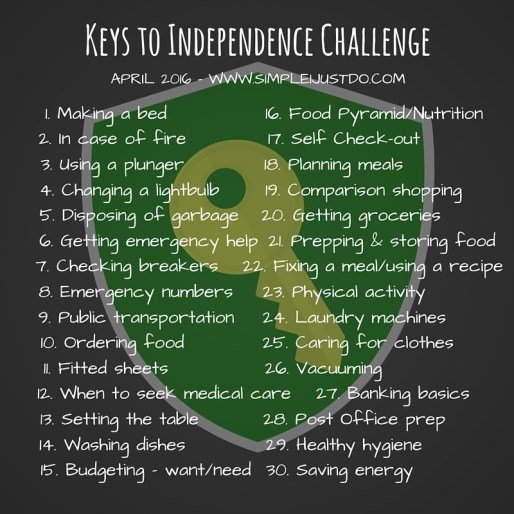
One of my greatest worries in life is what The Boy will do when I am gone. My goal, and the goal of most special needs parents, is to prepare my son to be the most independent person he can be. We don’t know yet what his living situation will be, nor do we know how and where he will work. But right now, I can prepare him for the basics, and I can do it by introducing him to things adults do every day. Each introduction may or may not be successful, but at least he will have had the experience so that we can build on it in the future.

Here is the Keys to Independence Challenge I mentioned last week.

Keys to Independence Challenge


How does this work?

For each day of the month of April, you attempt to introduce your child to the skills above. If they’ve already had experience with it or do it on a regular basis, try switching things up a bit to increase flexibility. If you’d like to document your work with a picture or a status update, you can do so on social media with the hashtag #keystoindependence so people can check it out and get some inspiration.

Is this only for teenagers?

Nope. You can totally do many of these with younger children, with a little forethought. It could just be learning about the skill rather than actually performing it, too.

Is this only for kids with special needs?

Heck no! I know some neurotypical adults who could benefit from this practice! 😉

What if we miss a day (or three or five)?

Hey, life happens. Especially in a special needs home. No worries! You can skip it completely, or come back to it in May, if you’d like.  No one is keeping score.

What if my kiddo doesn’t want to do it?

The Boy is of an age where he relishes the thought of being an adult, and having a little independence.  I’ve prepped him a bit for this, but I have some backup incentives, too. Think about what motivates your kiddo and see if you can’t build that into the challenge.

What if I don’t understand what the day’s task is?

Interpret for yourself, or check my facebook page or social media and search for the #keystoindependence hashtag – you’ll see at least my take on the day’s prompt.  I just opened up an Instagram account for this very purpose @SimpleIJustDo! But there are no right or wrong answers here.

What if I don’t want to post about it or post pictures?

No worries! You do you! But we’d love to hear how it’s going for you! If you do decide to post, just include the #keystoindependence hashtag so we can find you.

If you have more questions, feel free to let me know. I’ll be posting about the challenge on my facebook, twitter, and now instagram accounts if you want to follow. If not, I’ll still be posting about regular stuff, too.

As always, thanks for your support, and here’s to an enriching April!

Transition to High School: He Has No Idea

Last week, I wrote about the “attempt” by the district to get some input from The Boy regarding his future for our upcoming IEP meeting during which we will discuss the transition to high school. The amount of effort put into getting his input was exactly one worksheet, borrowed from another school district. At that time, I was too busy shaking my head to know exactly what to do next.

IMG_4678I took that worksheet and put it into a digestible format (PowerPoint), and added some possible answers for The Boy to choose. I didn’t send anything in on the “due date” which was Friday. Over the weekend, I sat down briefly with The Boy and the roughly 15 slides with questions about his future. “Hm,” he’d say. “Go to the next one,” and “I haven’t really thought about that before,” were common responses. To summarize, I got nothin’. Monday, I sent in my responses to the parent survey (it is now Tuesday morning, and they are still in his backpack, by the way), and emailed his special ed teacher to explain that he didn’t have much response to the student survey, and it was either because he really doesn’t have any idea, or he’s not comfortable sharing his ideas at this time. Her response was that she had a simpler survey format she could send home. No doubt copied from the same school district… I replied that I didn’t think it was the format, as I had modified that for him, but the content was the issue, and that he really has no response.

What do they expect? Mom asks 15 questions or hands him the worksheet and they’re magically going to get profound and thoughtful answers to just what is going on inside my son’s brain? For the umpteenth time in the past three years, I have to ask, “Are you NEW here? Do you not know ANYTHING about autism?”

A serious, thoughtful, student-centered approach would be to integrate some of this transition planning throughout the 8th grade year, directly within the “social skills class” curriculum… You know, that curriculum that the principal wants to change willy-nilly based on what she feels like is important for my son? But what do I know?

I sometimes wish I didn’t know how half-assed they are approaching my kid’s education. Maybe ignorance would be bliss. But I do know, and I’m powerless to change the culture of the school and the district. That change has to come from within. I can scream and shout and threaten legal action all I want, but change is terrifyingly slow in education, and even those on the inside are mostly powerless to change it, as well.

My only course of action is to muddle through and shake my head.


Do as I Say, Not as I Do

We’ve had much discussion over the past few weeks, the school and I, about executive functioning skills and the need for a homework folder so that I know that what comes home needs to be completed/signed/looked at and returned, and the teachers and TA know the same about things that come from home. His teacher offered up a cat folder two weeks ago… via email, and I haven’t seen a single cat folder since.

Last night, while retrieving The Boy’s band music from his backpack, I found a random envelope that said “return by 3/18,” which contained a “Student Dream Sheet” and a “Parent Transition Survey,” which I have filled out multiple times before. The “Student Dream Sheet” is new, however. I took one look at it and immediately thought, “Yeah, right.”

IMG_4678It is a front and back sheet with 15 open-ended questions on it. I get that they can’t supply multiple choice answers because they are trying to understand just what it is The Boy wants to do in his future, but really? Is this the best way? They really think that this is even a possibility for someone who is fairly nonverbal? And it’s “due” in three days?

I don’t even have words at the moment, and I’m not really sure what I’m going to do about it. Yes, he needs to be involved, and ideally answers to “What kind of job do you want when you graduate?” and “Where do you want to live after graduation?” are important for us to have when considering his high school plan. But to expect that I can just sit down with him in an evening and get these answers (no doubt, preferably in full sentences – ha!) belies how little thought, effort, and expertise is behind this whole thing anyway. Shouldn’t an “assessment” for an IEP meeting follow the dictates of the IEP? Shouldn’t educators modify an information-gathering tool to the child with specific special needs?

“Do you have any significant medical problems that need to be considered when determining post school goals?”

Really?

Updates and Upcoming

SPRING IS MY FAVORITE SEASONIt’s almost the end of February, which means it’s almost spring, which means, it’s almost IEP season. And at our next IEP meeting, I have to let the school know what we’ve decided about The Boy’s future – college or no. I’ve since found that isn’t technically accurate, but it may as well be, with all of the extra work The Boy would have to do just to get into college.

Before that time I would like to meet with the high school band director. I sat with The Boy on Tuesday night as his band warmed up for a pre-contest performance, and listened to him play. And that boy can play. I would absolutely hate for him to have to give it up. I also absolutely hate that this district has decided that they can dictate a child’s program and undermine this little thing called an Individualized Education Program

A friend and I have long wanted to meet with the director of special education, and I also think it’s high time we do that, to discuss how high school works here, and how it violates children’s rights. I may also mention a certain band director who has thankfully moved on from my child’s life, but is still negatively affecting those of other kiddos on the spectrum – another friend of mine had to pull her son out of his class because he was being yelled at, as in verbally abused. That’s four kids that I personally know on the spectrum who have been bullied by this guy, that he has attempted to force out of the program, and someone at the district level needs to know.

Before I do all of that, I will have to respond to The Boy’s current educators and see if I can help them connect the dots to try to make it through this school year. I intend to do this without calling another IEP meeting, but via email and a simple suggestion to contact the autism specialist if they are struggling with implementing strategies, and understanding how to help him meet IEP goals.

I sometimes wish I didn’t have to work so that I could have the time to properly manage all of this. And then I think, if I didn’t have to work, I would probably homeschool at this point, and wouldn’t have to!

I Can’t Fix This

“He must have neglected to turn it in.”

This is what The Boy’s language arts special education teacher told me when I let her know I had sent in the reading log for last week. She also said she doesn’t like to go into his backpack because it would be invading his privacy.

While I understand the sentiment, it smacks of ineptitude. That would be like a physical therapist ignoring your issue with your elbow because they didn’t want to ask you to expose it.

She went on to say that he is not completing work in class, which is an IEP goal, because he is spending too much time drawing. His TA (yes, his TA) came up with an incentive program for this, but the teacher claims that because the TA isn’t in her room for her classes, The Boy does not want to participate. And it’s hard because she’s got all the other kids in there.

Well, I’m sorry. Darn it, life is hard, and sometimes you just have to do your job. You can hope and wish and pray that your student with autism will suddenly find his missing executive functioning skills under a desk in the corner, but most people work on them instead. Because that’s what they get paid to do, and that’s what they’re in it for.

Could I call another IEP meeting? Sure. Would it do any good? I think you can cure this as much as you can cure autism itself. I think this is a response email, possibly cc’d to the TA who is the only freaking one at the school with a clue, and maybe we can muddle through the rest of 8th grade.

I hate that my son’s education has come to this. But there are only so many times you can bang your head against a wall. This particular issue is the teacher’s and not The Boy’s. And it’s not my job to fix it.

BANG HEAD HERE

Ask Them to Put It In Writing

Our local chapter of the Autism Society has a regular monthly “Friends and Fun” party at the rec center of a local church where kiddos on the spectrum and their siblings can come and celebrate their birthdays with other kiddos in a non-judgmental setting. We set up some games like Twister, and there are ping pong tables, and then there are also some more structured games, but no one is forced to play, only encouraged. There are snacks, cupcakes, balloons, and even presents for the birthday kids. For kiddos who attend and are not celebrating a birthday, it’s a chance to get some social interaction on their own terms.

It’s also an opportunity for autism parents to meet and vent about issues their having, seek comfort from those who understand, and even advice. This past weekend, I struck up a conversation with a mom who I have come to respect because of her knowledge of special education law, and her commiseration with the state of our school district when it comes to autism awareness. Over the past couple of months, I have been sharing with her what I’ve found out about the transition to high school, and she is eager to hear because her son is about two years behind The Boy.

I told her that it seems like we have two choices, and that the IEP will not be the driving force behind The Boy’s education, as it should be. I told her that I’m not sure how far I would get fighting the system as it is without involving lawyers and spending money I don’t have.

She shared a tip that worked for her, and I thought I would share it with you, as well.

When her son transitioned from primary to elementary school, they attempted to put him in the resource room for the entire day, even though he had had success at the primary school with the proper supports. She knew he could handle general ed classes with continued support and that the school was making this decision based on staffing. She simply told them to put their rationale for their decision in writing. Quickly, the school changed their tune, and her son was placed in general ed classes with supports.

Why?

Because when they put something in writing, they have to be able to defend it legally and they couldn’t. This tip is brilliant. It may not work as well for big issues, but for the smaller ones, it most definitely will, especially when you are dealing with personnel who are not all that familiar with the law, but know enough that putting things in writing could potentially come back to bite them in the ass.

Add this tip to your bag of tricks and pass it on. It’s simple, but potentially powerful.

ed law 101