The Times, They Are A-changin’

A few weeks ago, I wrote about how the pilot program that we fought to get The Boy into will not be extended into the high school.  And tomorrow, I meet with the IEP team to discuss the plans for next year, after hearing through the grapevine that the pilot program in the middle school is being stripped down, as well.  Hence, the fabulous “opportunity” to place The Boy into a resource room for all of his cores! Blech.  Do they really think I’m that dumb?  But I digress…

Our fear is that without the pilot program extending into the high school, the district will most likely re-assign The Boy back to his home school… Do you remember his home school? I do. It wasn’t a good experience. And if that middle school that he attended for one quarter was any indication, I doubt the high school he would attend would be remotely better.

The Man and I have been in deep discussion and thought ever since these changes became apparent.  We’ve been considering options for the future of our little family.  And we’ve been property-shopping.

Even before this all came about, The Man and I were keeping our eyes peeled for an affordable bit of property on which he could build us a house.  Not hire a builder to build us a house.  This would be The Man, building us a house, with the help of some of his friends in the trades.  You see, this has been a dream of his for awhile.

So when our hand was forced, and the school district seemed likely to change The Boy’s placement for the worse, The Man and I decided that now was the time to go all in, buy a plot of land, and start building on that end of the district so that, at the very least, The Boy could attend high school with people he knows.

We closed on our lot today.

New Beginnings

More change is coming our way, as building a new house means selling our current house, and living somewhere else temporarily until the new house is built.  A lot for a kiddo on the spectrum.  But I’ve already started prepping him.  And he is actually looking forward to being able to sleep in later and a much shorter bus ride. 🙂

IEPs and Trust

It’s IEP season again, and we have our appointment set.  We’ve also had a curious email from The Boy’s program teacher.  She was excited to tell me that they were going to offer science and social studies in a special ed classroom next year, as well as math and language arts, which The Boy already has.  He would be with students who are “academically equivalent” to him, but in classes taught by resource teachers. He would still have access to her social skills class and his elective classes.

IEP documentationConsidering the goal of special education is to place students in the least restrictive environment, and considering he would lose virtually all access to his neurotypical peers, I politely pointed out that I did not think this would be an appropriate placement for The Boy.  His program teacher cautioned me not to make any decisions just yet, because she felt this would be a good placement for him “due to his academics”.  Curious, because The Boy has gotten all A’s and B’s this year. I told her I wouldn’t rule it out, but at this time, I didn’t think it would work for him.

I added a post-script, and asked if she thought the pilot program in which The Boy participates in the Middle School would extend to the high school, to which she replied that she didn’t think so.

Fast-forward to a few days ago, when I heard from a friend whose son is in the program, as well.  She said she heard they may not continue the program at all, as in not even for next year’s 8th graders… And the tumbler clicks into place.

Even though I trust this person with my child each day, I cannot take her suggestions to heart because I fear she has been directed to encourage me to accept this put-all-the-kids-in-resource-room plan so that they can both comply with IEPs and discontinue the program. Once we change the IEP to say he needs to be in resource, they no longer have to fund a paraprofessional to be with him in his general ed classes. It’s not what’s best for the kids, but what’s best for the school district.

Silly school district! They continue to underestimate me, because I know the law, and I know my son’s rights.  They are going to have to have data to back up that he is “academically lacking” in his general ed classes to show that he needs so much more support as to be placed in a self-contained classroom, and removed from the general ed curriculum.  And they don’t have it.

Let the games begin.

Teachers: Please Educate Yourselves about IEPs and the Law

School LawLet me preface this by saying that I know the struggles faced by teachers everyday.  I understand the Sisyphean nature of the job, and that it is almost impossible to stay on top of all of the various responsibilities. When I taught, I quickly learned to prioritize those responsibilities, putting the ones that directly impacted kids at the very top.

Knowing your responsibilities to your special education students, and the legal ramifications if those responsibilities aren’t met should be one of your top priorities.

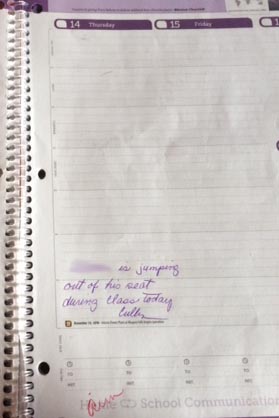
If you’ve followed Simple. I Just Do for awhile, you know that we encountered teachers at the beginning of The Boy’s 6th grade year who acted as if they had never had an autistic students in their classrooms before.  I had to become “that mom” just to ensure that The Boy was receiving the very basic modifications and accommodations.  Truthfully, his IEP was being violated on a daily basis.  Comments from teachers during that time included:

  • “He refused to take the test, so I gave him a zero”
  • “He doesn’t do any work in my room, so he needs to be in the special ed room during my class”
  • “He should take the test the same day as the rest of the class because we have other lessons that he would miss out on”
  • “If he doesn’t understand something, I don’t know how to help him because he won’t tell me what he doesn’t understand”

I have also found that classroom teachers in this state do not modify assignments themselves, most likely because they do not know how.  Somehow, providing these modifications is the responsibility of the special education teacher.  This was not the case in my training and experience up north.

Here’s the thing.  You, as a teacher, can be sued (and possibly have to pay damages out of your own pocket) for not following the IEP, and claiming ignorance will not be a sufficient defense.  Claiming that the special ed teacher didn’t make the modifications for you will not be a sufficient defense. You are responsible for knowing the law (IDEA and ADA, for starters), and for following it, by providing each student’s appropriate modifications.

This past week, I had to be “that mom” again, and send several emails to remind three different teachers about the modifications The Boy is supposed to be receiving.  In one response, from the band director, he mentioned that he was “willing to let (The Boy) play for” the band festival performance that same week, but that he did “not want him to participate in the sight reading portion.”

The Boy has a right to access the same curriculum as his peers, therefore he has a right to participate in both the band festival and the sight reading portion.  And it is the band director’s responsibility to know that.

Behavior Analysis for Dummies

I opened yesterday’s post with a series of oft-asked questions of parents of kiddos on the spectrum, the biggest of which I suspect is “Why in the hell is he doing that?”

There’s a lot of guilt one feels as a parent to a kiddo on the spectrum.  After the meltdown, or public incident, or whatever the negative behavior that just occurred was, we often think, “Was that my fault?  Did I do something wrong that caused that?” While feelings of guilt are rarely productive (although feelings are feelings and we can’t control them, really), this questions is a good starting point for a little behavior analysis.

You see, most autism parents already do this naturally, but may not know it had a name.

observation.jpgWhen your kiddo starts to have a problem at school, the IEP team may suggest a functional behavior assessment.  This is where someone (probably with a lot of credentials) will come in to observe your child over several days, and collect data about his/her schedule and routines, and more specifically, exactly what happens before the negative behavior occurs.  The reason they do this is to figure out the “trigger” for the negative behavior, so that we can better understand what the child is attempting to communicate through the negative behavior, and then plan strategies to avoid or minimize the trigger so that the negative behavior decreases, or plan strategies for how the kiddo can cope with a trigger that cannot be reduced or avoided.

Let’s say I get a phone call that The Boy is repeatedly attempting to escape from science class (yep, this happened in real life).  A functional behavior assessment would serve to identify if this is occurring at a consistent time, and what the cause might be – is it another child with lots of body spray sitting next to him? Is it the brightness or noise of the projector that is turned on next to his seat at the beginning of class each day?  Does he have to pee?  Does he have anxiety about being late to his next class?  Does he feel like he is missing something important elsewhere in the building? Is he frustrated because he doesn’t understand the material? Is there too much handwriting so he is falling behind?  Through observation, they can determine what the constant variable is whenever he escapes, and then come up with a plan (move the projector, move his seat, allow him to use a study buddy or word processor to take notes, have a talk with the teacher of his next class about being welcoming and not marking him late, or allow him to use the restroom when he needs to, rather than at passing time).  Strategies often include the use of motivators and rewards, as well, to give your kiddo positive reinforcement to keep up the good work. For instance, if The Boy uses the strategy put in place, and stopped escaping from science, he could earn some extra iPad time in social skills class.

You see, we autism parents often do the same thing at home.  It’s how I know to expect some hyperactivity after we have Goldfish, especially the multicolored kind – I discovered that through careful observation of my own. The triggers for negative behavior I mentioned yesterday came from careful observation of my own, as well.

So if you are ever ready to throw your hands up and scream “WHY??”, take a deep breath, grab a notebook, and start observing.  You already do this fancy thing called Behavior Analysis, and no one knows your kid better than you. You are no “dummy”.  It may take days, weeks, or months, but you’ll get to the bottom of it. You got this. 😉

Helpless and Dumb

Whenever I was sick as a child, my mom would say, “I hate it when you’re sick,” and I never truly understood the depth of that until I had my own child.  Today, I looked at The Boy and said, “I hate it when you’re upset,” and burst into tears.  “Why are you crying, Mom?” he asked.

I cry because I’m helpless and I know nothing.  I had to come and pick you up at school today because you wouldn’t go to class, and then tried to escape school.  I don’t know why.  No one does, and when we ask you, you start talking about your bus driver from last year, and how he must have retired because he doesn’t come to pick you up anymore. You talk about not going back to school until next week, or returning to that other middle school you went to for a quarter last year until I screamed enough to get you into a better one, the one you go to now.

I cry because I don’t understand your motivations, and I just want to make it better and easier for you.  Can we clarify the bus rules for you?  Let’s make a checklist so you don’t forget your band binder again. How can I make it better?  And I get no answer.

I cry because you are my only son, and I can’t see past this very day for you.  I hope I can get you on the bus tomorrow, but I don’t know if you will go.  I don’t know what will happen then.  I don’t even know if I will be able to return to work later today, if you will be able to calm down, if we will be able to come up with a reasonable plan to get you back to school and going to class.

I cry because there are no answers.  All of us autism parents just throw stuff onto the wall to see if it sticks every damn day.  Some of it sticks, and a whole hell of a lot of it doesn’t and you go back to the drawing board.  If I had a dollar for every time I said or thought “I don’t know what to do…”

All I can do is rely on experience, try, try, try, and hope, hope, hope.  But in the meantime, I hate it when he’s upset. 😦

Being Put Through My Paces

A meeting is scheduled.  With The Boy’s teachers.  Not yet an official IEP meeting, just an I’m-so-sick-of-you-not-knowing-what-you’re-doing meeting.  Nah, I won’t really say that.  But I do have dreams, yes DREAMS about running an inservice, actual PROFESSIONAL DEVELOPMENT for these teachers, and not just about how to effectively approach a student and his/her IEP, but about basic things like GRADING and ASSESSMENTS.

I was a decent teacher.  I don’t claim to have been the best teacher at the school where I worked, not by a long shot.  But I did know a thing or two about exactly how assessments (quizzes, tests, and projects to a normal person) are supposed to work, and how to effectively use and fairly grade those assessments, skills that The Boy’s teachers apparently haven’t yet mastered.

A 65/100 on a quiz with 10 multiple choice questions just doesn’t compute…

quiz

I guess I was spoiled by the staff I worked with.  We didn’t have to argue very long that grading a kid on effort just wasn’t fair to anyone, and definitely watered-down the picture of whether or not the student knew the content.  We didn’t have differing opinions on how much quizzes, tests, and projects should be worth — assignments and quizzes should rarely be worth more than 25 points or so, and tests and projects were usually between 50 and 100.  Assignments and quizzes, we agreed, showed how well the teacher was teaching the content (formative assessments), while tests and projects showed how well the student had learned the content (summative assessments).  To me, this is TEACHING 101.  Fellow teachers, Amiright?

This reminds me of the meeting I had at The Boy’s previous school where they thought the use of rubrics was such a novel idea… “We don’t really use those…” they said… (I was taught to use rubrics in my teaching in TEACHER COLLEGE in the 1990s… 20 years ago…).

My challenge is to attend this meeting and not come off as this know-it-all mom telling them how to do their jobs.  My challenge is gently nudge them towards doing their jobs without them realizing that I’m telling them how to do their jobs.

Time to get clever.

There Always Has to be One

It seems that every year, there is one teacher who just doesn’t get it.

I am overwhelmed by the amount of homework in The Boy’s science class this year, and it is supposedly being modified for him. This teacher refuses to give us study guides, insisting they are only made available for tests and not for quizzes.  However the quizzes cover an entire chapter and 40 slides from the PowerPoint they use in class.  What is assigned isn’t being communicated correctly in the planner, or conflicts with what is sent home via email.

I’ve been trying to communicate all of this to The Boy’s special education teacher, and she is doing her best, but she can’t control the general ed teacher and I don’t expect her to.  It’s just frustrating that yet again, I find myself providing the modifications for my son, and it’s just not my job.

modifications

This same teacher tried to “explain” to me in an email that he “grades on effort” because he knows that some students “struggle” more than others. Wrong thing to say to me. It offends me as a special needs mom, and it offends me as a former teacher.  There is nothing right with that statement.  I just have to figure out how much fight I have in me right now, and then I’ll figure out what to do next…

Re-training

plannershot1The downside of having a son with autism in secondary school is the sheer numbers of teachers we have to re-train each year.  And I’m only half-joking.  Most of the teachers we have encountered since the Big School Switch of ’13, have been accommodating and flexible, and have fallen in love with The Boy relatively quickly, wanting to do anything in their power to help him succeed.  But here we are at the beginning of a new school year, dealing with stuff that is very clearly spelled out in his IEP, and the teachers are not yet implementing.

One of The Boy’s IEP goals directly relates to his use of the agenda, speaks to his difficulties in this area, yet within the first two weeks of school, we still only had one teacher ensuring he was utilizing it in his class. Then the homework hit the fan this week, when I had no idea two assignments even existed before they were due in science and social studies.

I emailed the teachers last night, basically copying and pasting from last year’s introductory email, explaining The Boy’s need for help with communication, planner use, and the dire need for them to let me know what the hell is going on, but stated in much more genteel language.  And I got some nice responses.  Yet in today’s planner entry, there was clearly still some misunderstanding from whoever-it-was that was writing in the planner (clearly not the teacher – an aide? a substitute? Who IS this person telling me that his assignment wasn’t finished and needed to be finished by tomorrow??).

And then there were the assignments we had busted our butts to make sure he got done, that were returned in his planner this evening without having even been turned in.  Yet another area of difficulty, yet another area in need of training.

After several emails, I finally got some traction and his program teacher has agreed to meet with his teachers tomorrow to review this stuff so we can get him going on the right track before he gets too behind. Thank goodness I don’t have to re-train her every year! She’s worth her weight in gold. 🙂

Inclusion is still not a “thing”?

While reading the recent NPR article about inclusion, I realized that it’s still a subject of controversy, which puzzles me.  Because to me, the issue of inclusion is about basic human rights.  In America, every kid has the right to a free education, and the notion that some kids who “hinder” or “distract” kids who will actually make a “net contribution to society” and should therefore be stuck in a room somewhere sounds like something out of the 50s and 60s.  Have we really not traveled so far as to realize the “worth” of every human being, and their basic human rights, even in this country?

Wow.

I have to say I’m gobsmacked.  Many commenters were concerned about gifted kids being placed centrally in a classroom so they could help their peers during lessons, as if that were a disservice to that gifted child.  What?  We want to discourage helping others, now?  Because not being placed centrally in the classroom would help her achieve higher levels of giftedness?  Help me understand…

The Boy in his ASD room with compression blankets, sitting atop a pilates ball

The Boy in his ASD room with compression blankets, sitting atop a pilates ball

I am not necessarily a proponent of full inclusion, except when a student with disabilities is best served with full inclusion.  I prefer for my kid to have a safe space and some downtime in his school day, so that he doesn’t have to be “on” all day long.  I love that he has a space where he can be his true self, at least during lunch, and his social skills class.  If he didn’t, he would be ready to blow every day when he got home, and that ain’t good for anybody.  So I appreciate the sort of inclusion he gets – “Inclusion lite”, if you will.

But as I wrote in my recent post, I want him to be able to socialize with his neuro-typical peers, because that’s a thing.  He will need that in his lifetime, in order to succeed to the best of his abilities.  And in my humble opinion, he will need that more than knowledge about the Pharoahs of Egypt.  I want him to belong to his school community, and that just won’t happen if he is stuck in a separate room all day.

I shouldn’t let the trolls get to me, but every human being has worth, and my kid has more than most.  He deserves the same respect as every other kid on the block.  And he does have a very basic right to the same education every other 6th grader gets.

ESY Is Different Down Here

ESY, or Extended School Year, has been a mainstay of The Boy’s summer experience since he was six years old.  I have written about some of his experiences in the past, and he always looked forward to it when we lived up north.  Last year, he struggled with adapting to a summer day camp which did not include computers, and was not like school very much at all, although he ended up enjoying the experience and meeting some new (and long-lasting) friends.

Before we moved here, I asked some parents with whom I had connected in advance, through the autism society’s local chapter whether or not they knew anything about the local ESY program.  They had no idea what I was talking about…

“Uh-oh”, I thought.

When we went through the IEP process this year, the assistant director for special education for the school district was involved (because I was trying to get The Boy into his current program, and being the warrior mom that I need to be to get things done from time to time), and she indicated then that ESY for this summer would be a long-shot.  We would have to prove he needed it with data. “I’ve got six years of data backing me up,” I thought.

And this year’s IEP rolled around and his special ed teacher for language arts and math basically explained that even if he did qualify, which she clearly didn’t believe he did, it was very different from what we had experienced up north.  Down here, it was basically one-on-one tutoring with an aide for a few hours a week.

“Oh crap,” I thought.

I immediately began to devise activities with which I could supplement his summer camp – was there a computer camp or cartooning lessons I could find somewhere (and could I even afford it)?

The Boy’s program teacher called about two weeks later to let me know that they had determined that The Boy would qualify for ESY this year, because he had had it for so many years, and that they would continue to collect data next school year to determine whether or not he would qualify for the following year.

“Yay… kind of,” I thought.

Now we need to determine where this “ESY” experience will occur, and how often and for how long.  Luckily he will have his program teacher, which helps with the continuity.  But it remains to be seen how effective this brand of summer enrichment will be toward maintaining the structure and routine that most kids on the spectrum need through the summer months.

sandy boy