EC Planner: editorial calendar

Recently I sat down to figure out how I could back in the swing of things here at Simple. I Just Do.  I re-read some resources I had, and began planning (my favorite thing!), and realized I needed a space for an editorial calendar.  Then I realized I already had the perfect space, and it was under-utilized – the month-at-a-glance portion of my EC planner!

I had seen posts of others using the daily portion, but it didn’t really work for me.  So I sat down, did some brainstorming, analyzed some analytics, and came up with a whole slew of post topics, and even made up a little code for types of post.  I broke out the post-it notes (my second favorite thing!) and began “scheduling” these posts, making sure to plan a variety of types of posts, as well as topics.  Whatever posts that were not scheduled were put off to the side for revision and use in the future.  And if I get an idea for a post, now I just jot it on one of these small post-its, stick it in there, and it’ll be ready for next month’s planning session.  They are also really easy to move around – I had a different post planned for today, but it wasn’t ready, so I moved this one up a few weeks.  Easy peasy.

I’m also able to schedule my social media posts and interaction, linky parties, etc.

It may not be the most beautiful or elegant thing ever, but for me, the most important thing is it WORKS!  And I can make it beautiful later, when I get some time (yeah, right).  This is not an earth-shattering idea, but it’s always good to take a moment to reflect on what has worked in the past, think about what resources you have, and try to marry the two.  No sense in re-creating the wheel when you don’t have to. In fact that’s something good to do in just about every area of your life.  Sounds like a topic for another blog post… now where are my post-its?

Making Money on Autism

There are lots of autism bloggers, and lots of single moms with kiddos on the spectrum. Lots of us have learned so much from experience, and lots of us want to share that because we know how hard it can be.  And there a few of us who have the ability to make a few bucks doing this.

Way back when I started this blog, one of the things that inspired me was the inability to find existing social stories online that weren’t for sale.  I was tired of being nickel-and-dimed for every little resource I needed for The Boy.  Others had experienced just what we were going through, and someone had to have a social story already written, so that I wouldn’t have to re-create the wheel every time, but they were all for sale. And money is hard to come by when your paying for uninsured therapies, prescriptions, diapers or your 5 year old… It’s tough.

I have long considered trying to take this blog to the next level, and maybe “go pro” which means trying to attract companies to advertise here. Most bloggers do this, and I don’t see it as trying to make money off of other autism or special needs parents.  Advertising is everywhere, and I don’t think anyone would see this as a blogger trying to take advantage of her audience.

There are other bloggers that sell stuff on their sites, as well.  And I think we have to be very careful when we head in that direction.  T-shirts are one thing.  Resources are another.  Trust me – I understand the sentiment behind it – when you work hard to create something, you have a tendency to want to protect it, and while you want to share it with the world, you feel you deserve something in return.  I get it.  But we cannot forget that person on the other end, spending money on therapy, weighted blankets, chewies, and special gluten-free ingredients.  Our community needs to remain one in which we share resources at little cost, and respect each other’s struggles. If we forget that, we’ve lost our way.

The autism community needs to stick together

5 Ways to Support the Newly Diagnosed

finding the path after diagnosis of autismI often think back to the day we got The Boy’s diagnosis.  The ex and I went our separate ways – he went back to work, and I drove to a nearby Kmart parking lot to process (i.e. cry my eyes out, hyperventilate, ask myself over and over “What are we going to do?” and eventually call a close friend to talk me through it.  Thank God for her.) The psychologist we had seen had written “Autism Society of America” on the back of a business card, suggested we look them up, and said goodbye.

Once I collected myself, I still didn’t know what I needed, or what our next steps were.  As I think most do, I went to the internet.  Unfortunately, the internet is a big place, and I’m not sure the right tools and support are readily accessible to someone doing their first post-diagnosis search.

So how can we support parents who are new to this whole kit and caboodle?

1.  Support local nonprofits that directly help our kiddos.  The more those groups are supported, the more visible they can be in the community, and the more likely it will be that someone hearing that diagnosis for the first time will recognize the group as a resource they can use.  This means supporting them with money, with attendance at events and workshops, and with your volunteer hours.  Yes, volunteer hours.  It may seem like we have the perfect excuse not to volunteer, but we have to give back if only to our own community – if we don’t, who will?

2.  Make your presence known at the school.  Kids with a new diagnosis will have parents with questions.  They will most likely be asking those questions at the school. If you have maintained a good relationship with staff while dealing with the school, they may just see you as a resource for parents who are new to this whole shindig, and may pass your name along.  Or if there is a group of you parents, even a social group, that goes for you, too.  Schools really do want to help, and may attempt to connect someone with questions to those who may have answers (that’s you!).

3.  Use social media to post “the good stuff” to your friends, and encourage them to share it.  Parents who have questions will inevitably be some of your friends, or friends of friends, and so on.  The more “the good stuff” gets shared and posted, the more people will see it, the more it will be found by those searching for it.  That’s how the interwebs works for good.

4.  When they come to your group, be welcoming.  You may think this goes without saying, but groups are a funny thing.  Sometimes, a group can get an attitude with newbies, and can be judgmental. You don’t have to like everyone who comes to the group for help and support, but the fact remains they need help (and they may need more help than others!).

5.  Respect the process.  People react differently to the news of a diagnosis.  Some will immediately seek out others for help, while others will remain private and need to sort through things on their own.  Don’t be pushy.  Allow them to come to terms with it, and just be a friend.  Just knowing there are others who are going through what you are going through goes a long way, especially at the beginning.

Special needs parents have many, many roles.  One of them should be “guide to others who have just joined the group.”  What would you add to this list?

CHIP: It needs to be on your radar

CHIP stands for Child Health Insurance Program and is a federal program administered by each state, and funded by both federal and state governments.  Sometimes it goes by a different name, but essentially it is for children in families who don’t qualify for Medicaid, but still are low income enough to struggle paying for health insurance for their child.  It came into existence before the ACA was passed, but it continues to exist because it is a widely popular program that provides a needed service to many, many families.

Through the ACA, the terms of CHIP eligibility were extended through 2019, but the funding was not.  Funding expires for the current incarnation of CHIP through this September.

Here’s why it matters.  If funding is not extended, many, many children will lose their healthcare.  The Boy included.

The other night, I happened to click on an article on Facebook, that happened to include the information above, and left me upset and worried.  Why hadn’t I heard anything about this?  Shouldn’t this be national news?  What the hell is going on?

I did a little more research, and found that it will most likely receive extended funding, but no one knows for how long.  The problem is that some want it replaced with plans offered by the health exchanges.  I can tell you that this would place healthcare on the other side of affordable for our family, because our state neither expanded medicaid, nor started their own exchange.  As a result, there is one company providing healthcare plans in the my state (through the federal exchange), and therefore they can set whatever rates they want – there is no competition, which was the whole point of the ACA.  The ACA is perverted here, and therefore, we are not being served the way we should be by this law.

There are many people who think families should have a choice between an ACA plan and CHIP, and there are others who think having CHIP and the ACA separate is just fine.  Needless to say, there will probably be a great deal of debate on September 30th of this year.

I wonder if we will hear anything about it?

I wonder if it will be used as a bargaining chip (no pun intended) for something else?

I wonder, and I worry.  CHIP gives me piece of mind about my son’s healthcare, and I would really prefer to have an educated public and a compassionate legislative body making decisions about its future.

Children's Health Insurance Program

Posting Embarrassing Stuff About Our Kids on the Spectrum

So many times I see something on Facebook or twitter, and without me realizing it, it starts me thinking. Thinking leads to writing, and then when I want to refer back to what triggered the thinking, I have no idea where it is, was, or will be.  I apologize for that because I feel I should link back to the source, and if I find it, I will. Sometimes I wonder if its better not to include it, because I don’t want to criticize anyone in particular, just highlight my take on it…

The other day, someone posted on Facebook about how we autism bloggers have a responsibility to our kiddos not to post embarrassing stuff about them on our blogs.  Things their friends may read, things no one would really want posted on the world-wide inter webs for everyone to see.  This is what started me thinking.

This person pointed out the distinction that some blogs take great pains to mask the identity of their kiddo, as I feel I do.  No clear pictures of faces, no names, no locations.  There are people who know The Boy directly who read this blog, but they are all adults who care about him as a person, and would never think differently about him no matter what I posted.

I did a mental review of the types of things I post and could only come up with a handful that might be considered embarrassing for The Boy. And I started to feel a little guilty despite the fact that none of his friends would be able to know this blog was about him.

As long as his identity is a secret, he can do anything!

But I thought some more.  Mostly about why I started this blog in the first place.  It really is astounding when you hear people’s stories about getting “The Diagnosis” – in every single one I have ever read or heard, they felt like they were handed the information and ushered to the door with a “Have a nice day!” and a door slammed in their face.  This is apparently still a problem.  People are given this life-altering information and no help.  I started this blog to share my experiences, so that we could navigate this thing called autism together, so that there would be somewhere someone could go to find out more than what’s in the pamphlet you’re handed as the psychologist turns to the next patient to diagnose.

And some of that stuff is embarrassing.  Our kiddos have deficits in areas neuro-typical kids don’t have to worry about – potty training until 5, or 7, or 12, not knowing bathroom etiquette, puberty… Yes, it’s not stuff a typical kid would like plastered all of the web.  But you have to balance that with the community’s need for strategies, their need to share, their need to brainstorm.

I hope I can walk that tightrope of sharing without invading my son’s privacy.  After all, I am his mom, and capable of making lots of decisions about his life.  As he grows older, I do need to get out of the way and let him advocate for himself and have some independence, but in this case, I think he would be all for helping someone else like him who was struggling, as long as I continue to maintain his anonymity.

This is a grey area for sure. And I may not be right, but it’s the best decision I can make with the information and values I have at my disposal.  Thoughts?

5 Tips for Autism Parents for “Dealing with the School”

autism & schoolI’m a latecomer to this.  We were very lucky with The Boy’s elementary school, and his elementary teachers, in particular his ASD teachers who really acted like caseworkers, made sure everything ran as smoothly as possible.  They advocated for the kids with other teachers and with administration, they handled little problems as they came up, they didn’t think the world was ending with every not-so-good day, and thank goodness they were the foundation, the bedrock if you will, of The Boy’s education.

They spoiled us, but they also showed us how it was supposed to be.

When we moved south, I was shocked at how bad a school could handle it’s special education students.  So I fought to get a better placement for The Boy, because I knew it existed, and I knew we would lose him if we didn’t.  And we got it.

Better, but not perfect.  If you follow my blog regularly, you know that even now we have issues with certain teachers who just don’t get it, strange schedule changes that don’t make sense, and administrators all too quick to wash their hands of anything that comes up. In short, I still have to “deal with the school” from time to time, and the following are some of the best strategies I have found over the years for getting what you want from them.

1.  Listen and watch to determine who your allies are.  Before we moved here, I contacted the local autism society who put me in touch with the autism specialist for the county. She was supposed to be this fantastic resource, but I’ve watched her and listened to her, and to this day, I don’t consider her an ally.  She almost prevented The Boy from switching schools, and I’ve seen how she has handled other situations with other parents, and I’m not impressed.  On the other hand, through that placement process, I was impressed with the assistant superintendent for special education – she cut through the bull on the second day of our IEP meeting (with 14 members present), and brought some chart paper to illustrate that this really was a no-brainer, and the best placement was at his current school. If you watch and listen, you can determine who might be a good resource, and someone to turn to when something’s not right.

2.  Never trust anyone 100%.  Unfortunately, you always have to be wary, because in a school setting, people are not always at liberty to say what they really want to say, and sometimes, due to the nature of autism, they will bend the truth about something that happened (or didn’t happen), or not tell you at all.  A friend recently had a conference with two teachers, one of whom was a revered special ed teacher.  The friend and her son walked into the meeting, expecting to meet with cooperative teachers trying to find a solution, and the revered teacher began to yell at the son for disrespecting his mom at home.  My friend was so taken aback, she asked her son to leave the room, and in her words, “if that was supposed to be support for me, it definitely didn’t feel like it!” People are people, and they make mistakes.  They also change, and teachers get tired. It’s a tough lesson to learn, but just because you could depend on someone “on the inside” in the past, doesn’t mean that will always be the case.

3.  Don’t belittle the teachers.  I read on another autism blog’s Facebook page recently something about actual quotes from IEPs she’s been involved in, and it said something like “I am a taxpayer and I pay your salary!”  Ummm, no.  As a former teacher, this is just about the worst and most alienating thing you can say. Many times, teachers’ hands are so bound by mandates and the wishes of the district and administration that they have little to no power, even over what happens in their own classrooms.  Saying things like this ensures that they will not be your allies, and that can turn out really badly, in the end.

4.  Keep a poker face.  It’s ok, and even advisable to play dumb from time to time.  Earlier this year, The Boy got in trouble for making noises when entering his last class, which is supposed to be a social skills class with his autism teacher.  She had decided it was going to be a silent class, and you can imagine how well that went over with The Boy, who understandably feels like he can let loose a little at the end of the day in his little autism community.  And his teacher escalated the situation, making him more and more angry and upset.  She emailed me with a long list of all the things he had done.  Rather than retaliate, and explain to her about autism (as she clearly had forgotten all of her training for that hour), i suggested that The Boy may have needed to *insert any usual autistic reaction here*.  I could have gone off on her, asking her what the hell she was thinking, and didn’t she know that kids on the spectrum stim and make noises, and to make a social skills class a silent period is the definition of stupidity, but I didn’t.  I simply let her know that The Boy may have had a hard time with it.  Don’t tell them how to do their jobs, even if you know better than they do. Play dumb, and remind them that your kid is a kid, and will make mistakes from time to time.  Together we have to teach them what’s appropriate sometimes.

5.  Pick your battles.  Most autism parents are very familiar with this, but realizing school is not the be-all, end-all was a big a-ha moment for me.  I don’t care so much about grades, because they are based on a standardized norm, and my kid is not standardized, and definitely not the norm.  I care if he learns the content more, but again, our home life is more important than the Types of Energy and the Pharaohs of Egypt.  I have given up on the science teacher this year, who rather than modify assignments, is choosing to give my child grades based on effort.  I can’t teach him science, so I guess he just won’t get much out of the class this year.  Disappointing, but not the end of the world.  The teachers (even the autism teacher) are still giving us only a day’s notice about tests and quizzes, so when that happens, we do what we can but I don’t stress. He usually does pretty well, and what do tests show, anyway? Sometimes you bang your head on a brick wall until you realize it hurts, and then you move on.

Some of these tips seem contradictory, but they aren’t.  They’ve all helped me navigate for better resources and understanding for The Boy, and I hope you can use them too.  Do you have any tips of your own?  Share them in the comments, please!

Shared on amamasstory.com – visit her Mama Moments Monday Link-up!

Anti-Resolutions

I’ve said before that resolutions aren’t really my thing.  And they’re still not.  But today, I did yoga for the second time in two weeks (and before that in a loooooong time).  And once this past week, I pulled out my flute and played for about an hour.  Last weekend, I got The Boy out of bed and I went to the beach (even though it was freezing) to take a couple of shots with my new camera – I have to practice using the manual settings – Yay!

I’m trying to be more positive at work, and get more accomplished at both work and home.  I’m trying not to let social media rule my evening so I can enjoy some time with The Man.

These are all things I’d like to continue doing this year, but I haven’t identified any resolutions, because I don’t want to set myself up for failure, and then be disappointed.  So instead, I will just try to form these habits, these good habits.

And it all begins with that first time.

Planner Supplies

Last week, I told you I’d let you know about some of the supplies I’ve picked up for my Erin Condren planner.

  • Post-Its  I love post-it notes, and have them in just about every size, and I used these at first to keep track of events that were tentative in my planner, or things I wanted to remember but didn’t have a strip of wash tape to jot it down on.  I still use them a bit, but not as much as I used to.  I like the ones in bright colors, so they catch my eye and do what they’re supposed to do – remind me of something important!
  • Printable planner stickers from etsy  I bought some full-sheet sticker paper for my printer, and then printed these colorful stickers (that say “bill” and “shopping” and “date night” just to name a few) that I then cut by hand.  It uses a lot of ink, however, so I’m not sure I’ll do this again.  We’ll see.
  • Washi tape I have a new addiction to this stuff, and unfortunately, it ain’t cheap.  But Michael’s sells a bunch of rolls in one tube, and if you can wait for a good sale or coupon, you can get a good deal.  I think they run about $20 for 13 rolls, and I got mine half-off.  Not bad when most places charge you around $4 per roll.  I always keep an eye out for some on clearance at Walmart, as well.  Washi tape is good for keeping track of events in your planner that cover several days.  I also use it instead of the stickers that came with the EC planner, because it is much easier to move – the EC stickers are supposed to be re-positionable, but aren’t very cooperative.
  • Frixion markers I picked a set of these up on Amazon for about $12, and they are life-transforming.  OK, maybe not, but pretty darn close.  They are markers that you can erase, which is GREAT for someone who loves pops of color to help her remember things, but hates the permanence of regular markers.  PLUS, they don’t bleed through the page.
  • Stickers I adore the kawaii and mochi style stickers, but haven’t committed the money to order any yet.  In the meantime, I’ve been checking my regular craft outlets and the dollar store for some cute ones to add a little something here and there.  I got these monster stickers at Walmart for $1. I use triangle-shaped ones to indicate when a bill has been paid.

Mornings Suck in Autism Households

That is my theory based on the anecdotal evidence I have encountered.  Maybe not for everyone, but for a lot of people I know that have loved ones on the spectrum.

One morning this week, everything was running along splendidly until I suggested to The Boy that it might be a jacket day as it was below 50 degrees.  No problem!  Yes, he agreed.  A jacket was a good idea.

And then we got to the couch, the time to put on socks and shoes, and wait for the bus.  And the bus was early, and The Boy couldn’t find his hat.  And there was NO WAY he was going to school without his hat…

Add in the stray kitten who had hung outside of the house since the previous evening, meowing away – he was trying to get in while I was marching out to the bus in my robe and slippers to plead for a few more minutes, and Raphael was anxious to get out because he always is, and because he was very curious about this kitten.  Add all of that to The (intransigent) Boy stuffing his feet, face, and hands into the couch cushions to ensure he couldn’t go to school without his hat.

Finally, he’s out the door, but not without a stream of under-the-breath curses about hats and school and buses.  I climb back into bed, and The Man says, “Maybe you should set that stuff out the night before.”

(Can you imagine the dark look?)

Yep.  Mornings suck.


PS – Guess where the hat was?  Right next to his bed.  *facepalm*

Sex Ed for Sale

Before break, 7th graders at The Boy’s school had a week-long sex ed program.  A couple of days in advance, an opt-out form was sent home that also explained where materials could be viewed (in the library, something like the following day in the middle of the day – very realistic for working parents, but I digress). I have never opted out of these programs for The Boy in the past because I feel it’s important, and I want him to have access to the same curriculum as his peers.

About the second day of the week, I noticed that the “workbook” for the program was in The Boy’s backpack and thought I would sit down and see what was in it.

The first page I had a problem with claimed that condoms were ineffective against STDs, and that only abstinence would ensure that you would not get an STD.  Half right, in my estimation.  I went to the CDC website to fact-check the information on the page, and actually found that this workbook page contained some inaccurate statements.

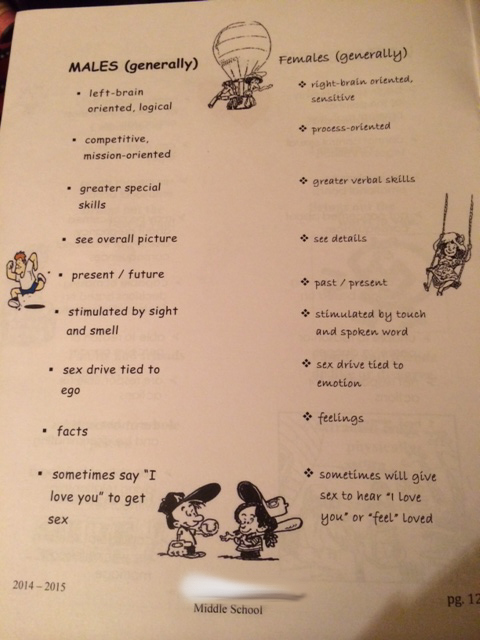
Concerned, I continued to read the workbook.  And then I came to this page:

gender

Ah, boys are logical and girls are sensitive.  Boys deal in facts, and girls deal in feelings.  All couched in “sometimes” and “generally” which are the equivalent to “no offense but…”.

Nope.  Not acceptable.  Not even “generally”.  And then, I found this:

marriage?

Check out Attitude #6.  Because if you don’t want to get married, there’s something wrong with you.

What in the world is this crap they are teaching the 7th graders in my county? I googled the name of the group that put the curriculum together.  It’s actually a women’s pregnancy clinic that maintains an anti-abortion stance, and sells this curriculum to school districts.  A pregnancy clinic that doesn’t even know the facts about STDs and condoms.

I emailed the principal, knowing that this curriculum was probably selected by a committee, and was approved and paid for by the school board.  I asked her who I might contact with concerns about the program.  She took several days to email back, and even then only said that one of the counselors would be contacting me about my concern.

At least a week and a half went by before a school counselor called me and referred me to… drumroll, please… the pregnancy clinic that published the curriculum.

That would be like referring a library patron with concerns about pornography in the library to Larry Flynt.

I will be pursuing this with central office.  I will attend board meetings if I have to.  This curriculum is insanely out of date, and presents opinion as fact, which is a very slippery slope.  I just wish I had had better access to this in advance, and I wish the school had handled my concerns more appropriately.  I’m extremely disappointed with their response.