Summer Camp?

Our state and local chapters of the Autism Society held a meeting last night regarding all of the new and wonderful programming they are bringing to our area, focusing primarily on their summer day camp at a new-to-us facility that has been remodeled and improved. I was excited to get the information, find out about registration and see how much it would cost. While The Boy has enjoyed the summer program he has attended the past few years, it wasn’t quite what he needed, although something was better than nothing. And if the school district claims he doesn’t qualify for ESY, it was our only alternative.

This new program will be for six weeks (six weeks!), Monday through Friday (all week!), from 9am to 5pm (amazing!). And it will be free… Wait, what?

And there are only 30 slots.

Wait, what?

They went on to explain that first priority would be given to kids who do not receive any state services (pretty much everyone I know because you have to sacrifice your first born to get any kind of services around here), and to those who can attend the whole 6 weeks. OK, and do you not realize you are going to have hundreds of kids who fit that description? How will you decide among them?

Then they said it was open to kids with all diagnoses, and even siblings if there was room. And then they said it would be open to anyone in the area, not just people in our county…

A little bit of market research would have been appropriate here. I can’t believe they think that so few would be interested in this. I guess I’ll be up at Midnight on May 1, hoping the site doesn’t crash and trying to get registered before everyone else in the tri-county area…

hanging out


Anxiety about the Unkown

When I was about 10, my parents and I watched “Iceman,” a movie about a neanderthal man found in ice and resuscitated. The question I had for my mom at the end was if it was ever possible for us to return to that state of being – unfamiliar with the technology of the day, and possessing only the most meager of skills. She answered that it was possible in the event of a nuclear war (this was in the mid-80s). Unbeknownst to her, I began to panic about the possibility of nuclear war, and the media coverage of the cold war only fed my frenzy to the point that I was afraid when I heard planes flying overhead, thinking it was the Russians about to drop the bomb.

My dad finally talked me off that ledge (he really would have been a fantastic teacher or counselor) one night, explaining to me that my fears were not founded in logic, and that I was safe.

I went about my life, and I was fine.

But every once in awhile, I get gripped by a current worry, and it turns into an irrational fixation. The internet is a wonderful tool and the most fantastic invention of our time, but during these moments, it is my worst enemy. Rather than trusting my own intuition, experience, and intelligence, I go searching for an answer from strangers who don’t know me or my situation. The answer must be out there, I tell myself.

how I worryAnd so, with my child’s future seemingly in the balance, and a boy who looked at me with panic in his eyes last night, asking “Do I have to quit band?” this is where I am today. In front of the computer, searching for answers, for someone to tell me the right thing to do. Do I choose one of the pre-existing paths for The Boy to follow through high school, possibly denying him access to college or, on the other hand, subjecting him to years of struggle and stress in general ed classes with little support? Do I try to blaze a new trail and fight for a hybrid that is legally his right (with little hope of succeeding)? Do I fight for  him to be in marching band when I’m not sure whether his love for it is more obsession or genuine interest? Do I just pull him out and homeschool (somehow)?

For my sake, I’m putting it out of my mind for a bit, waiting to hear when the meeting with the director of special ed will occur, and asking for the IEP to be postponed at least a week. Coping through distraction and delay. :/


An Autism Registry?

While perusing my usual Facebook stream, I came across an article about two brothers on the spectrum who created an autism registry and are working to make it live in their state with the aim of helping law enforcement understand when a person they need to speak with has autism.

While I applaud the ingenuity and self-advocacy of the brothers, and understand the intent, this still strikes me as the wrong way to go. Unfortunately, many law enforcement personnel in this country do not yet have CIT training (crisis intervention training), which is the basic understanding that people they deal with may have mental health or neurological issues, and need to be approached in a different fashion. It’s a very real problem with those on the spectrum ending up arrested for refusing to identify themselves or lashing out at officers. This was a major reason we spoke with the sheriff’s department ourselves when the MHP owner reported The Boy to them for things he did not do. The Boy got to see the inside of the Chief Deputy’s vehicle and now he knows him by name and sight, and the Chief Deputy has a relationship with my child so if there ever is a situation, he will hopefully be seen as a person with special needs rather than a perp.

A registry has scary connotations, and possible unintended consequences. My child is not a danger to others, which is what most registries are used for. Registries are also used for public reference, like the sex offender registry. Will people be able to access this registry so that they can choose whether or not to purchase a home near a child with autism?

The premise of a registry is that the people on it are different and need to be classified. While I accept that those on the spectrum may not be neurotypical, they are now 1 in 68 of us – is that really so different?

And finally, I keep coming back to this question in my current battles with the schools. Would you do the same to a child with cerebral palsy? juvenile diabetes? Down’s Syndrome?

Rather than settle for a second-best precaution, I think we need to spend more time and effort on getting all law enforcement officers CIT training. If the premise in education is that any intervention that helps a student with an IEP could help (and probably will help) children without one, shouldn’t that premise extend to law enforcement? That any intervention extended to a person with special needs would benefit a person without them? If we approach each other as people first, many of these issues would not exist.

So, no registry for us, thankyouverymuch. We will stick with building personal relationships within our community. You?

Orientation

high schoolFor most, high school orientation is an exciting time. I watched the 8th graders sit quietly and listen to the high school administration and teachers speak in the auditorium, and afterwards wander the halls, almost running at times they were so excited to see their friends and figure out how the building was laid out. During the presentation they were told what classes they would have to take as a freshman, and that they may not got the electives they want because they build the schedule from seniors down. They were told about foreign language, core classes, Career and Technical Ed classes, and counseling services.
Not once did they mention IEPs or 504s.

Few teachers were there, and only two out of the three counselors for the entire 900-student population were there. It was not a night designed to speak to teachers, or counselors, even though they made themselves available in the hallway after the presentation.

I spoke to the band director who had been a no-show for a meeting the previous day during my lunch period (drove 20 minutes to the school, waited 20 minutes while he was in a meeting with the principal, drove 20 minutes back to work). He took the wind out of my sails by saying The Boy may be able to participate in band second semester if they add a second, more remedial band like they hope to, but that was pretty much our only option at this point. This Boy who adores band, probably has perfect pitch, and wants to be a band director…

I attempted to speak to the counselor in the hallway to find out just how all of this scheduling would happen with us, but another parent cut right in front of me, and by that time I was frustrated, tired, and hungry so we walked away, and I allowed The Boy one more stop in our wandering tour before leaving.

A registration form came home two days ago, and since, again, I had thought this would be handled by the IEP, I emailed The Boy’s special ed teacher, the one who coordinates his program and the IEP meetings. She responded that she is on indefinite medical leave and had no idea, maybe I should email Mrs. X…

I asked The Boy how long his teacher had been gone. “Since last week,” he said.

As a result of all of this, I am disappointed, anxious, angry, and frustrated. And my attempt to meet with the director of special education was met with a promise of a phone call. I’m afraid if she does follow through with the phone call today, she may get an earful.

Special Education should not be an afterthought, an attempt to comply with the law. Special Education should not be something separate that isn’t talked about. Special Education should not be a reason to exclude kids.

And I should not have to pull teeth to find out information about my child’s educational experiences and program in the coming year.

This is unacceptable.

Evolution of a Stepdad

The Man and I have been married for almost three years, and together for about six and a half. He’s been involved in The Boy’s life since he was nine years old. As I’ve mentioned before, he was the one to teach him how to ride a bike, he’s taught him to surf, how to operate the riding lawnmower, and countless other life lessons (including using the plunger the other night!). The ex was around until The Boy was six and a half. Suffice it to say that The Man has been more of a dad to The Boy in his memory.

When we first married, The Man was quick to classify his relationship to The Boy. “That’s my stepson,” he’d say when we were introduced to someone new. It never hurt me or The Boy to be introduced in this way, but it was something I noticed. You see, The Man has a grown daughter he doesn’t see much. And she was very young when he and her mom split up. Then she moved six hours away, but he made the effort to be in her life, made the drive to see her every other weekend, took her on trips, chaperoned her school trip to Washington DC, brought her to the beach in the summer, paid for much of her college and her car, and actually paid more than what he was asked in child support. He sees the other side of the coin, and always respected the fact that the ex was and is The Boy’s dad. He never wanted to replace him.

But over the years, that line has softened. He has grown protective of our boy. He is more comfortable voicing his opinions on his upbringing (while respecting the fact that I have the final say). The two of them have begun to have their own private jokes and rituals. And he often refers to him as “our son,” in casual conversation with others who may not know the whole situation. And I notice. ❤

like riding a bike

Baby, I’m Amazed

We’ve been keeping up with the #keystoindependence challenge, and I have to say in the short time we’ve begun, I have already learned so much about my son.

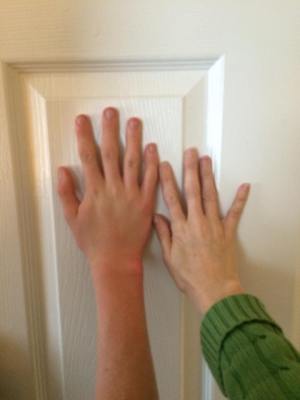
12933009_738098856325388_789378537205830466_nOn day 2, when I was teaching him about fire safety, I was amazed at how little he knew about what to do in a fire. I know that in his nine years in school, they have had various fire safety discussions, assemblies, etc. But The Boy pretty much had no clue about first feeling the door, and crawling to avoid smoke. Then I was blown away again by how quickly he learned it, and retained it. When The Man got home, I asked The Boy to tell him what he learned, and he did. When I asked him to tell Grammy & Poppy what he learned the next day, he did. No repetition was necessary, no flashcards… Just role play. Amazing.

Yesterday, we tackled changing a lightbulb. I showed him where we keep them and how to check to see if it’s a good bulb or not by shaking it. We went to the office and found a lamp that wasn’t being used. I showed him how to unscrew the bulb, and screw the new one in. I asked him to try and he hesitated to touch either bulb because he thought they were hot. I had to convince him that they were both cold – he had just seen me touch both of them, but still thought he might get burned.

I think as parents we assume our kids know a heck of lot more than they actually do. I think some of us still don’t realize we are the adults, and it is our job to adult now, and teach our kids how to do the same. I think all of this is human nature. I think that’s why we need to challenge ourselves a bunch. I thought this month would be about me teaching The Boy necessary skills, and it is. But he is teaching me so much more, as usual. ❤

April, Autism, Awareness, and Acceptance

Unfortunately, the autism community is polarized (and therefore paralyzed) on many issues. It’s fairly divisive (go figure in these days and times!), and people have widely differing views on everything from person-first language to vaccines. We can’t even agree on what to do with our little month of April. For most, “awareness” of autism doesn’t cut it, and we should be seeking “acceptance” of our kiddos and their behaviors, needs, and neurology from the general populace. Some (myself included) feel like awareness is a necessary first step that leads to acceptance, but others are not content to be patient with the rest of the world.

I get it.

But if we as a community continue to argue about every issue that exists, the result could be worse than a lack of awareness. If the message is muddled or unclear, no one hears it.

We need to agree to disagree on the issues that divide us. Table them until we can tackle each in its own time. Focus on one thing that will do the most good for those on the spectrum.

In my humble opinion, this one thing would be autism awareness and competence of our nation’s educators.

It is unfathomable to me that teachers across the country are still unaware of the core deficits of autism. They are as of yet unaware that an IEP is a federal document, and a binding agreement to which they are held accountable. They do not know how to make simple modifications and accommodations for a growing segment of their student population. And of course I do not mean all, or even most teachers in this country. But our special ed teachers need help, folks. If our kiddos have a right to the least restrictive environment, we want them in general ed classrooms with teachers who have a clue. Because let’s face it – our kids are at school each day much longer than they are at home. And if they are met with adults who see them as a “problem” or ” more work” or are just clueless in general about how they work, how devastating is that to this entire generation?

If the community could just get behind one urgent issue, this would get my vote, and I don’t think we’re very divided on this one.

This would be my wish for April and the autism community at large.

Dear Autism Community

No Info

One of the biggest struggles I have as a parent to an autistic child is that others are not as prepared as I am. If there’s one thing I’ve learned in the nine years since The Boy was diagnosed, it is that you need to do the groundwork in advance, or the likelihood of a meltdown or other avoidable issue increases. For example, when you know dad will probably cancel Spring Break, have a plan B to distract The Boy from his disappointment. Learn which restaurants only serve soda pop, so you can either avoid them or bring your own juice boxes. Half days before break are going to be hell, so find out who will be absent, prepare The Boy as much as you can, and hunker down.

hands-coffee-smartphone-technologyLast night, I got a text from The Boy’s band director. “Wear your band shirts tomorrow for pictures.” Um… The Boy wore his band shirt yesterday. If I had known, say last week, I could have prepared a bit better. No meltdown this time, because I just made him take it off as soon as I got the text to avoid spillage, but he’s basically wearing the same thing to school two days in row. *sigh*
It’s almost April, and I’m remembering why we used to have The Boy’s physical scheduled for February… camp applications. Except the local Autism Society chapter has great and exciting news (that they’re having a hard time getting the word out about) – they will be hosting an overnight camp and a day camp this summer! Great! How about some information to go along with that, like dates, and say… physical requirements? Because if it gets to June, and there are no more spaces, or we didn’t get a physical in time, I’ll have a melted kid on the sidewalk…

I know I can’t rightly expect the rest of the world to conform to our needs, but whatever happened to a little advance notice? I don’t think I’m asking too much, and I know people get busy, but seriously? IEP questionnaires that get sent home two days before they’re due, no information yet for chaperones for a trip to Washington DC in May, no word yet on when our spring IEP might be…

The Boy is not alone in his anxiety :/

Keys to Independence Challenge

One of my greatest worries in life is what The Boy will do when I am gone. My goal, and the goal of most special needs parents, is to prepare my son to be the most independent person he can be. We don’t know yet what his living situation will be, nor do we know how and where he will work. But right now, I can prepare him for the basics, and I can do it by introducing him to things adults do every day. Each introduction may or may not be successful, but at least he will have had the experience so that we can build on it in the future.

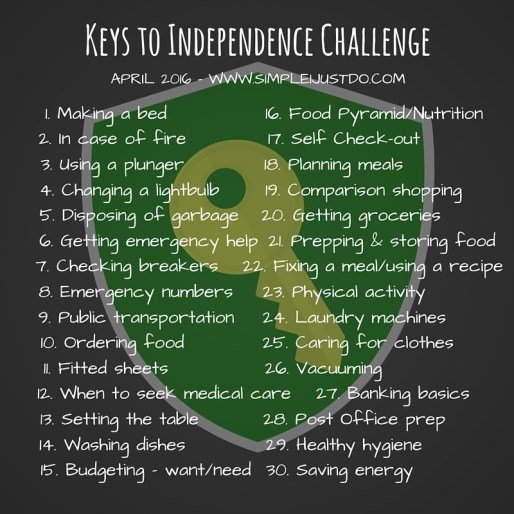
Here is the Keys to Independence Challenge I mentioned last week.

Keys to Independence Challenge


How does this work?

For each day of the month of April, you attempt to introduce your child to the skills above. If they’ve already had experience with it or do it on a regular basis, try switching things up a bit to increase flexibility. If you’d like to document your work with a picture or a status update, you can do so on social media with the hashtag #keystoindependence so people can check it out and get some inspiration.

Is this only for teenagers?

Nope. You can totally do many of these with younger children, with a little forethought. It could just be learning about the skill rather than actually performing it, too.

Is this only for kids with special needs?

Heck no! I know some neurotypical adults who could benefit from this practice! 😉

What if we miss a day (or three or five)?

Hey, life happens. Especially in a special needs home. No worries! You can skip it completely, or come back to it in May, if you’d like.  No one is keeping score.

What if my kiddo doesn’t want to do it?

The Boy is of an age where he relishes the thought of being an adult, and having a little independence.  I’ve prepped him a bit for this, but I have some backup incentives, too. Think about what motivates your kiddo and see if you can’t build that into the challenge.

What if I don’t understand what the day’s task is?

Interpret for yourself, or check my facebook page or social media and search for the #keystoindependence hashtag – you’ll see at least my take on the day’s prompt.  I just opened up an Instagram account for this very purpose @SimpleIJustDo! But there are no right or wrong answers here.

What if I don’t want to post about it or post pictures?

No worries! You do you! But we’d love to hear how it’s going for you! If you do decide to post, just include the #keystoindependence hashtag so we can find you.

If you have more questions, feel free to let me know. I’ll be posting about the challenge on my facebook, twitter, and now instagram accounts if you want to follow. If not, I’ll still be posting about regular stuff, too.

As always, thanks for your support, and here’s to an enriching April!

Keys to Independence: A Challenge

Recently, Grammy & Poppy left town for a few days, and rather than disrupt The Boy’s routine, we planned for him to still go to their home after school to hang out until The Man or I could come to pick him up. In preparation for this, I had a spare key made, thinking I would give it to The Boy, show him how to work the lock, and let him practice for a few days. Except that the key I had made didn’t work, and when I attempted to show him, he got frustrated lightning-quick, and didn’t want to try anymore.

We resolved that situation another way, but it has me thinking about all of the things a 14 year old on the spectrum should be practicing for the day when he has a bit more independence. You see, we are both tired after our long days of work, and I don’t push too much at home, especially during the week. Weekends, I ask a little more, and now and then there are certain chores he helps me do. But I know we could do so much more, and work on that lightning-quick frustration level, too.

Planner nerds and Bullet Journal Junkies often have monthly challenges, and the idea is to take something you’d like to practice, like doodling or hand lettering, and do it each day with a guided prompt. You commit to the challenge, you do the prompts, and you share with a special hashtag on social media (and lots of people miss days, or get “caught up” later if they get behind – no worries). I’ve been thinking about doing an Independence Skills Challenge for the month of April, which also happens to be Autism Awareness Month. There will be a list of “prompts,” or specific independence skills to encourage each day or couple of days. I will share more details next week, and I would love it if you would join us with your own kiddos (on the spectrum or not!), but I’m excited, even if The Boy and I are the only ones doing it.

Keys to Ind Chall